Why Consistency Matters for Your Fitness Results


Consistency in fitness is the practice of repeating regular exercise habits over time until they produce measurable, lasting change. It predicts training outcomes better than workout intensity, program complexity, or any single session’s effort. Research analyzing over 30,000 participants confirms that meaningful physiological adaptations require 12–24 months of sustained effort. The American College of Sports Medicine and researchers like Dr. Stuart Phillips at McMaster University have both pointed to adherence as the core variable separating people who get results from those who don’t. Understanding why consistency matters in fitness changes how you plan, train, and think about progress.
Why does consistency matter more than workout intensity?
Consistency beats intensity because the body adapts to repeated stimuli, not occasional shocks. A single brutal workout does not build muscle or cardiovascular capacity. Repeated, moderate effort applied week after week does.
A 2015 Journal of Behavioral Medicine study confirmed that exercise adherence predicts health outcomes better than workout type, intensity, or program design. That finding reframes the entire conversation about fitness. The question is not “what is the best program?” It is “what will you actually keep doing?”
Participants on moderate programs who stuck with their training consistently outperformed people following complex periodized plans with low adherence. Sophisticated programming is worthless if you quit by week six. Dropout and program switching reduce effectiveness regardless of how well the plan is designed.

Dr. Stuart Phillips advises that the best resistance training is whatever you can stick to at least twice a week. That is not a low bar. It is a recognition that sustainability is the actual performance variable.
Factor | Typical approach | Outcome with low adherence | Outcome with high adherence |
Intensity | High effort, short bursts | Burnout, injury, dropout | Moderate gains if sustained |
Program complexity | Advanced periodization | Confusion, switching, no progress | Strong gains if followed fully |
Consistency | Moderate, repeatable effort | N/A | Reliable, compounding adaptation |
Pro Tip: Start with a workout schedule you could maintain even during a stressful week. If it only works when life is perfect, it will not work for long.
What are the physiological and psychological benefits of regular exercise?
The body does not transform in weeks. Real physiological change, including increased muscle mass, improved cardiovascular efficiency, and a faster resting metabolism, requires 12–24 months of adherence. That timeline surprises most people. It also explains why so many quit too early.
Consistent training triggers progressive neuromuscular adaptations, meaning your nervous system learns to recruit muscle fibers more efficiently before the muscle itself visibly grows. Cardiovascular improvements follow a similar slow curve. The heart becomes more efficient at pumping blood, resting heart rate drops, and VO2 max climbs, but only with months of repeated aerobic stimulus.
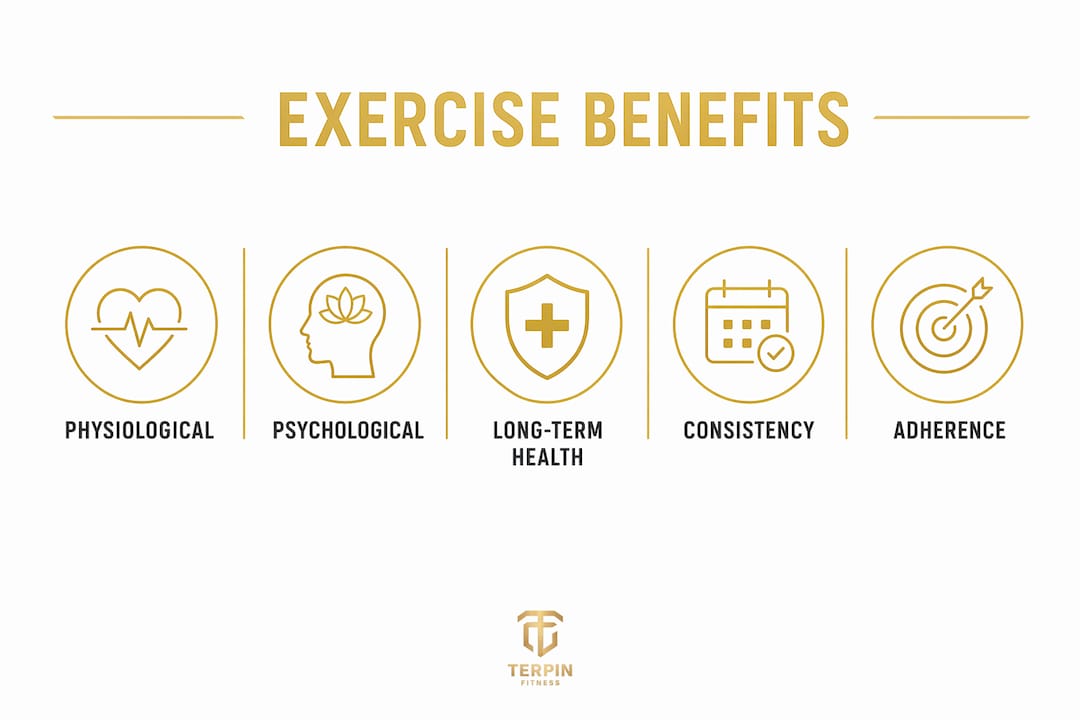
The psychological benefits of regular exercise are just as significant. Routine exercise reduces symptoms of anxiety and depression, improves sleep quality, and raises baseline energy. These effects compound over time. A person who trains three times a week for a year does not just look different. They think differently about their body and their capacity.
The most underrated benefit is the identity shift. Shifting from “someone trying to exercise” to “someone who trains” reduces decision fatigue and makes showing up automatic. That psychological reframe is not motivational fluff. It is a behavioral mechanism that removes the daily negotiation about whether to work out.
Key physiological and psychological benefits of consistent exercise include:
Increased lean muscle mass through progressive overload applied over months
Improved cardiovascular efficiency and lower resting heart rate
Enhanced insulin sensitivity and metabolic rate
Reduced symptoms of anxiety, depression, and chronic stress
Better sleep quality and daytime energy levels
Stronger immune function from regular moderate activity
A durable sense of physical identity that supports long-term adherence
How does regular exercise lead to better long-term health outcomes?
Consistent moderate exercise reduces disease risk and mortality more reliably than occasional high-intensity sessions. The World Health Organization recommends a minimum of 150 minutes of moderate-intensity exercise per week for substantial health benefits. That threshold is achievable. It is roughly 30 minutes on five days.
The mortality data is striking. Running once a week at a slow pace reduces all-cause mortality risk by 27%. The key word is “once a week.” Frequency and regularity matter more than duration or speed. That single weekly run, maintained over years, produces a measurable survival advantage.
The compounding effect of small, consistent inputs is real. Daily 30-minute walks accumulate to more than 180 hours of movement per year. A person who exercises sporadically, doing two-hour sessions once a month, logs far less total volume. Consistency wins on total accumulated work, not peak effort.
Sporadic intense exercise carries its own risks. Irregular training spikes injury rates because the body has not adapted to the load. Burnout follows when effort is unsustainable. Consistent moderate exercise avoids both problems by keeping the body in a state of gradual, managed adaptation.
Exercise pattern | Annual movement volume | Injury risk | Long-term health impact |
Daily 30-min walks | 180+ hours | Low | Strong reduction in mortality and disease risk |
3x weekly moderate training | 150+ hours | Low to moderate | Significant cardiovascular and metabolic benefit |
Sporadic intense sessions | Under 50 hours | High | Minimal sustained benefit, elevated burnout risk |
What practical strategies help build a consistent fitness routine?
Building consistency starts with removing friction. Embedding workouts into a weekly schedule and choosing a convenient location or simple equipment lowers the barrier to showing up. A gym 20 minutes away is harder to use than a set of loop resistance bands at home. Accessibility is not laziness. It is smart habit design.
Realistic goal setting matters just as much. Most people set 90-day goals for changes that require 18 months. That mismatch creates the feeling of failure even when progress is happening. Reframing the timeline to 12–24 months removes the pressure that causes early dropout.
Allowing for missed workouts within a consistent framework builds long-term resilience. A rigid program that collapses the moment you miss a session is fragile. A flexible routine that absorbs a missed week and continues is durable. Perfection is not the goal. Returning quickly is.
A personal trainer accelerates habit formation by removing guesswork from programming and providing external accountability. Terpinfit works with clients in Pensacola and online to build sustainable training plans that prioritize repeatable effort over complexity.
Steps to build a lasting fitness routine:
Choose a workout time that fits your existing schedule, not an ideal one
Start with two to three sessions per week and add frequency only after 8 weeks of adherence
Keep early workouts short enough that skipping feels harder than doing them
Track attendance, not performance, for the first three months
Build in a planned recovery day so rest is part of the program, not a failure of it
Shift your self-description from “trying to get fit” to “someone who trains regularly”
Work with a coach to communicate your goals and build a plan you can actually follow
Pro Tip: Place your workout gear where you will see it the night before. Visual cues reduce the mental effort of starting and are one of the simplest behavioral tools available.
Key Takeaways
Consistency is the single most reliable driver of fitness results because it produces compounding physiological and psychological adaptations that no single intense effort can replicate.
Point | Details |
Consistency beats intensity | Adherence predicts outcomes better than program type, intensity, or design. |
Adaptations take time | Meaningful physiological changes require 12–24 months of sustained training. |
Small inputs compound | Daily 30-minute walks accumulate to 180+ hours of movement per year. |
Identity shift matters | Seeing yourself as someone who trains reduces decision fatigue and dropout. |
Reduce friction first | Accessible equipment and a fixed schedule are the foundation of lasting habits. |
What I’ve learned coaching people who actually stick with it
The biggest misconception I see is that people treat fitness like a sprint. They go hard for six weeks, see partial results, and then either plateau or burn out. They blame the program. The program is rarely the problem.
What I have observed coaching clients in Pensacola and online is that the people who make the most progress are not the most intense. They are the most boring. They show up on Tuesday and Thursday, they do their sets, and they go home. They do not chase soreness. They do not switch programs every month. They just keep going.
The hardest thing to teach is patience with the timeline. Constantly switching programs reinforces the false belief that a better program is the answer. It is not. Sustained effort on a simple, adequate program beats a perfect plan executed for four weeks every single time.
The other thing I push back on is the idea that missing a workout is a failure. Missing one session inside a consistent framework means nothing. Missing one session and then quitting for three weeks because the streak is broken is the real problem. Build a routine that can absorb disruption and keep moving.
— Marc
How Terpinfit helps you build real fitness consistency
Knowing that consistency matters and actually building it are two different problems. Terpinfit offers both online and in-person personal training in Pensacola, Florida, with programs built around sustainable effort rather than complicated weekly variations.

Every Terpinfit program starts with a realistic schedule and a clear 12-month framework so you know what to expect and when. Whether you train remotely or in person, the focus is on adherence first and intensity second. If you are ready to stop restarting and start building, visit the Terpinfit services page to fill out an inquiry form and get started with a plan built around your life.
FAQ
How often should I exercise to see results?
The WHO recommends at least 150 minutes of moderate activity per week. Two to three consistent sessions per week is enough to produce measurable results over time.
Is consistency more important than how hard I work out?
Yes. A 2015 Journal of Behavioral Medicine study confirmed that exercise adherence predicts health outcomes better than intensity or program design. Showing up regularly matters more than pushing harder.
How long does it take to see fitness results from consistent training?
Visible and measurable physiological adaptations typically require 12–24 months of sustained effort. Early improvements in energy, sleep, and strength appear sooner, often within 6–8 weeks.
What is the best way to stay consistent with a fitness routine?
Start with a schedule that fits your current life, choose accessible equipment or a nearby location, and allow for occasional missed sessions without abandoning the routine entirely.
Does missing a workout hurt my progress?
One missed session inside a consistent routine has no meaningful impact on results. The risk is using a missed workout as a reason to stop. Returning quickly is what separates consistent people from inconsistent ones.
Recommended
Comments