How to Track Fitness Progress Weekly and Stay Motivated


Tracking fitness progress weekly means measuring key performance indicators consistently to confirm real improvement over time. The most effective weekly tracking system combines total training volume, strength output, cardio performance, and recovery quality into a single fitness progress log. Experts recommend a 12-week training cycle with checkpoints at weeks 1, 4, 8, and 12. That structure gives you enough data to spot trends without reacting to daily noise. When you track weekly progress with this level of detail, weight loss goals become measurable targets rather than vague hopes.
How to track fitness progress weekly with the right metrics
The single most important number in your weekly fitness tracking is total training volume. Volume equals sets multiplied by reps multiplied by weight lifted. This formula captures every variable in a single figure, so you can see whether your total training volume is climbing week over week. A rising volume number confirms progressive overload, which is the mechanism behind muscle growth and fat loss.
Strength, cardio, and recovery each need their own column in your fitness progress log. Balanced tracking across all three pillars prevents the common mistake of chasing one metric while ignoring the others. A person who tracks only weight lifted often overtrain and stall. A person who tracks only cardio minutes misses strength gains that accelerate fat burning.
The specific data points to capture each week include:
Exercises performed: name, sets, reps, and weight for every lift
Cardio output: duration, distance, or heart rate zone for each session
Energy levels: a simple 1–10 score before and after each workout
Recovery indicators: sleep hours, soreness rating, and resting heart rate
Personal bests: any new record in weight, reps, or pace
Progress photos belong in your weekly workout assessment too. Photos taken in consistent lighting and angles at weeks 1, 4, 8, and 12 reveal body composition changes that the scale hides. Water retention and muscle gain can mask fat loss for weeks at a time. A photo comparison cuts through that confusion immediately.
Pro Tip: Log your data immediately after each workout, before you shower or leave the gym. Memory fades fast, and a 30-second entry right after training is far more accurate than reconstructing it hours later.

What tools make weekly fitness tracking easier?
The right tool is the one you will actually use every single day. Three main categories exist: printed paper logs, digital spreadsheets, and mobile apps. Each has a different strength.
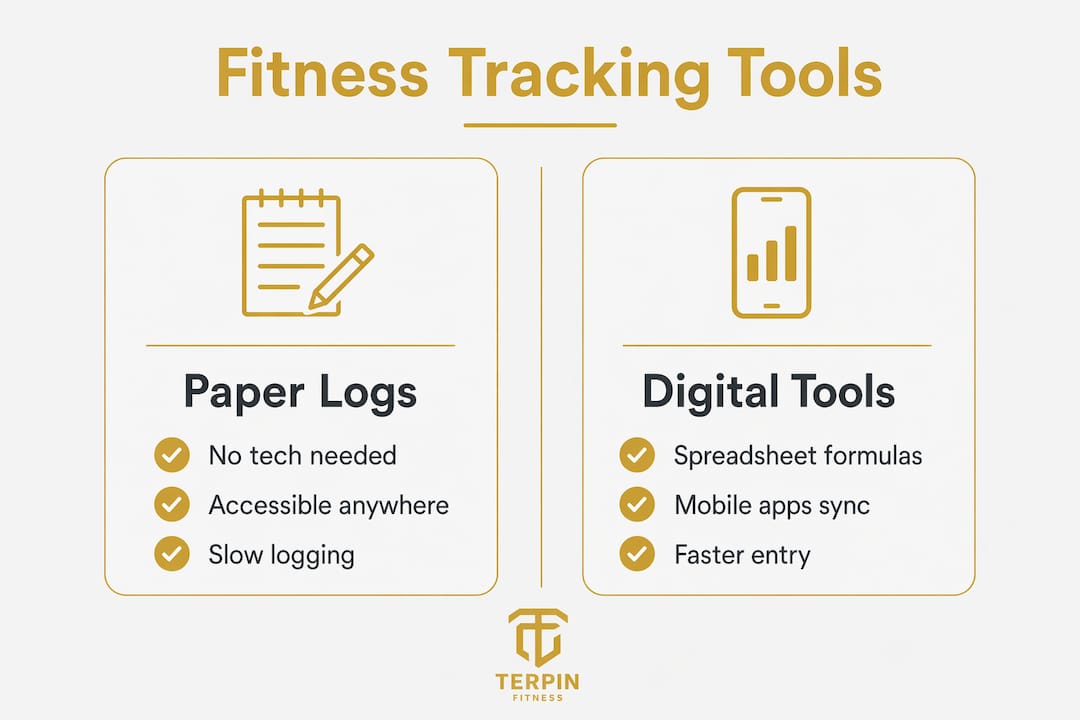
Paper logs require zero technology and work anywhere. A printed 12-week template with columns for date, exercise, sets, reps, and weight covers the basics. The downside is that calculating total volume by hand takes time, and spotting trends across multiple weeks requires manual review.
Digital spreadsheets like Google Sheets solve the calculation problem. You can build a formula that computes weekly volume automatically and create charts that show your progress curve at a glance. Spreadsheets also allow you to customize columns for energy scores, recovery notes, and cardio data in one place.
Mobile apps add the advantage of wearable integration. When your app syncs with a heart rate monitor or fitness watch, physiological data like resting heart rate and sleep quality feeds directly into your weekly summary. That removes the guesswork from recovery tracking.
Feature category | Paper log | Spreadsheet | Mobile app |
Logging speed | Slow | Medium | Fast |
Volume calculation | Manual | Automatic | Automatic |
Visual charts | None | Custom | Built-in |
Wearable sync | No | Limited | Yes |
Recovery tracking | Manual notes | Manual notes | Automated |
The best tool combines strength, cardio, and recovery logging in one place. Splitting data across three separate systems creates gaps and makes weekly review harder. Consolidation is the goal.
Pro Tip: If you use a mobile app, turn on notifications for your weekly summary review. Scheduling a fixed 10-minute review every Sunday evening turns data collection into a real decision-making habit.
How to set and adjust weekly fitness goals based on your progress
Data-driven weekly goals outperform arbitrary targets every time. Setting a goal like “increase total volume by 5% this week” gives you a number to chase. Setting a goal like “work harder” gives you nothing to measure. Adaptive weekly plans that adjust based on physiological recovery data maintain motivation better than fixed plans that ignore how your body actually feels.
The process works in three steps. First, review last week’s summary, including total volume, personal bests, energy scores, and recovery ratings. Second, identify one area that improved and one that needs attention. Third, set next week’s targets based on that evidence, not on what you think you should be doing.
Recovery feedback changes everything. If your resting heart rate is elevated and your energy score averaged 4 out of 10, pushing for a volume increase is the wrong call. Dropping intensity by 10–15% that week protects long-term progress. Ignoring recovery data is the fastest route to injury and burnout. Learning how to measure fitness progress accurately includes knowing when to pull back, not just when to push forward.
Focusing on “winning the week” rather than perfecting every day builds sustainable fitness habits more effectively. Missing one workout does not erase a week of good training. Tracking completion streaks across all three fitness pillars, strength, cardio, and recovery, keeps motivation intact even when life interrupts your schedule.
Common mistakes to avoid when setting or adjusting weekly goals:
Changing too many variables at once, making it impossible to know what caused improvement
Setting goals based on what you did at your peak rather than your current baseline
Ignoring recovery metrics and treating every week as a maximum effort week
Comparing your weekly numbers to someone else’s instead of your own previous week
Abandoning the log entirely after one bad week instead of adjusting and continuing
What are the common challenges in weekly fitness tracking?
Inconsistent logging is the most common reason weekly tracking fails. Missing two or three days of entries makes your weekly summary unreliable. The fix is a non-negotiable logging rule: if the workout happened, it gets logged the same day. No exceptions.
Scale weight fluctuations mislead people more than any other metric. Body weight can shift by 2–5 pounds in a single day based on water intake, sodium, and hormonal cycles. Treating a single weigh-in as a progress indicator creates false alarms. Weekly summaries that include personal bests, energy levels, and total volume give a far more accurate picture of real progress than daily scale readings.
Progress plateaus feel discouraging, but they carry useful information. A plateau in total volume often signals that a deload week is overdue. Tracking volume trends over four to six weeks reveals whether you need to reduce intensity, change exercise selection, or simply rest. A deload week at reduced intensity every fourth week prevents burnout and restores performance.
Pro Tip: When motivation dips, pull up your week 1 data and compare it to your current numbers. Seeing that your squat volume doubled or your cardio pace improved by 15% is more motivating than any external encouragement.
Maintaining motivation when progress stalls requires shifting your focus from outcomes to behaviors. You cannot control whether the scale moves this week. You can control whether you logged every workout, hit your sleep target, and completed your cardio sessions. Tracking behaviors alongside outcomes keeps your consistency in fitness intact during slow periods.
Additional best practices for accurate weekly tracking:
Take progress photos at the same time of day, in the same location, and under the same lighting every time
Weigh yourself on the same day each week, at the same time, under the same conditions
Log subjective notes like mood and stress levels alongside objective data
Review your weekly summary before planning the next week, not after you have already started it
Key Takeaways
Tracking fitness progress weekly with total volume, recovery data, and progress photos gives you the most complete and honest picture of your results.
Point | Details |
Use total volume as your core metric | Calculate sets x reps x weight each week to confirm progressive overload is happening. |
Track all three fitness pillars | Log strength, cardio, and recovery equally to avoid imbalances and prevent injury. |
Set data-driven weekly goals | Base next week’s targets on last week’s actual performance and recovery scores. |
Use photos alongside scale weight | Progress photos at consistent intervals reveal body composition changes the scale misses. |
Win the week, not every day | Track weekly completion streaks across all pillars to stay motivated through imperfect days. |
Why I think most people are tracking the wrong thing
Most people who start a fitness log focus almost entirely on scale weight. I understand why. It is the most visible number and the easiest to check. But after working with clients at Terpinfit, I can tell you that scale weight is the least reliable indicator of real progress, especially in the first 8–12 weeks of a program.
The clients who see the best long-term results are the ones who track total volume and recovery together. When someone tells me they feel stuck, the first thing I do is pull up their volume data. Almost every time, the numbers show steady progress even when the scale has not moved. That disconnect between perceived progress and actual progress is what kills motivation for most people.
Progress photos changed how I coach. I started requiring them at weeks 1, 4, 8, and 12 because clients consistently underestimate how much their body composition has shifted. Seeing a side-by-side comparison from week 1 to week 8 is more motivating than any pep talk. The data was always there. They just needed a way to see it.
The other thing I have learned is that rigid weekly goals backfire. A client who sets a volume target without accounting for a stressful work week or poor sleep will either miss the goal and feel like a failure, or hit it by overtraining and get injured. Adaptive goals that respond to recovery feedback are not a compromise. They are the smarter approach. If you want to build a tracking habit that actually sticks, read more about building an accountability routine that works with your real life, not against it.
— Marc
Personal training in Pensacola that tracks your progress for you
Self-tracking works well once you know what to measure and how to adjust. Getting to that point takes time, and most people benefit from expert guidance during the learning curve.

Terpinfit offers both online and in-person personal training in Pensacola built around structured weekly progress monitoring. Every program includes custom goal-setting, volume tracking, and regular check-ins so your plan adapts as your body does. You get the accountability of a coach who reviews your data alongside you, not just a generic program to follow alone. If you are ready to stop guessing and start seeing real weekly results, book a session with Terpinfit and get a plan built around your numbers.
FAQ
How often should I track my fitness progress?
Weekly tracking gives you enough data to spot real trends without overreacting to daily fluctuations. A structured 12-week cycle with formal check-ins at weeks 1, 4, 8, and 12 provides the clearest picture of long-term progress.
What is the best metric to track weekly for weight loss?
Total training volume, calculated as sets multiplied by reps multiplied by weight, is the most reliable weekly metric. It confirms progressive overload is occurring, which drives both muscle retention and fat loss.
Why does the scale not show my progress?
Water retention, muscle gain, and hormonal cycles can shift body weight by several pounds without any change in fat mass. Progress photos and total volume data reveal body composition changes that scale weight consistently masks.
How do I stay motivated when weekly progress stalls?
Compare your current data to your week 1 baseline rather than to last week alone. Shifting focus to behavioral streaks, such as workouts completed and sleep targets hit, maintains motivation when outcome numbers temporarily plateau.
When should I take a deload week?
Schedule a deload week every fourth week or whenever your energy scores drop consistently and your total volume stops increasing. Reducing training intensity by 10–15% for one week restores performance and prevents burnout.
Recommended
Comments