Habit Stacking Fitness: Build Workouts That Stick


Habit stacking fitness is the practice of attaching new exercise behaviors onto existing daily habits to make workouts automatic and consistent. The concept draws on the brain’s natural tendency to link actions into chains, so each completed behavior triggers the next. A 2023 meta-analysis of 14 randomized controlled trials confirmed that habit stacking improves adherence to exercise routines when habits are simple and clearly defined. The formal term in behavioral science is “implementation intention chaining,” but habit stacking is the phrase most fitness coaches and researchers use in practice. Terpinfit applies this method with clients in Pensacola and online to build workout routines that survive real life.
What is habit stacking in fitness, and why does it work?
Habit stacking in fitness is the deliberate act of linking a new workout behavior to an existing, reliable habit. The existing habit acts as a cue. The new fitness behavior follows automatically, without requiring a separate decision.
The mechanism behind this is the habit loop: cue, craving, response, reward. Your brain runs this loop thousands of times a day without conscious effort. When you attach a fitness behavior to a cue your brain already recognizes, the workout gets pulled into that automatic loop. You stop relying on motivation and start relying on structure.

The benefits of habit stacking go beyond convenience. Habit chains reduce decision fatigue by removing the moment-to-moment question of “should I work out now?” That question is where most fitness routines die. When the answer is already built into your morning routine, the question never comes up.
Workout cues serve as powerful anchors. Common examples include brewing coffee, brushing teeth, or arriving home from work. Each of these is an unmissable daily event. Attach a fitness behavior to one of them, and you have a reliable trigger that fires every day without effort.
Pro Tip: Pick a cue that already happens at the same time and place every day. Consistency of location and timing makes the chain form faster.
How does a 10-step fitness habit stack actually look?
A structured 10-step habit stack covers three phases: pre-workout preparation, the active workout, and post-workout recovery. Each step connects to the next, so finishing one action automatically starts the next. The full chain takes roughly 60–90 minutes, but most individual steps take under five minutes.
Step | Action | Phase | Time |
1 | Set out workout gear the night before | Pre-workout | 2 min |
2 | Wake up and drink 16 oz of water | Pre-workout | 1 min |
3 | Put on workout clothes immediately | Pre-workout | 2 min |
4 | Take pre-workout nutrition or a light snack | Pre-workout | 5 min |
5 | Do a 5-minute dynamic warm-up | Workout | 5 min |
6 | Complete the main workout session | Workout | 30–45 min |
7 | Finish with a 5-minute cooldown stretch | Workout | 5 min |
8 | Drink a protein shake or recovery meal | Post-workout | 5 min |
9 | Log the session in a notebook or app | Post-workout | 2 min |
10 | Set gear out for the next session | Post-workout | 2 min |
Step 10 loops directly back to Step 1. That loop is what makes the stack self-sustaining after the first 30 days.
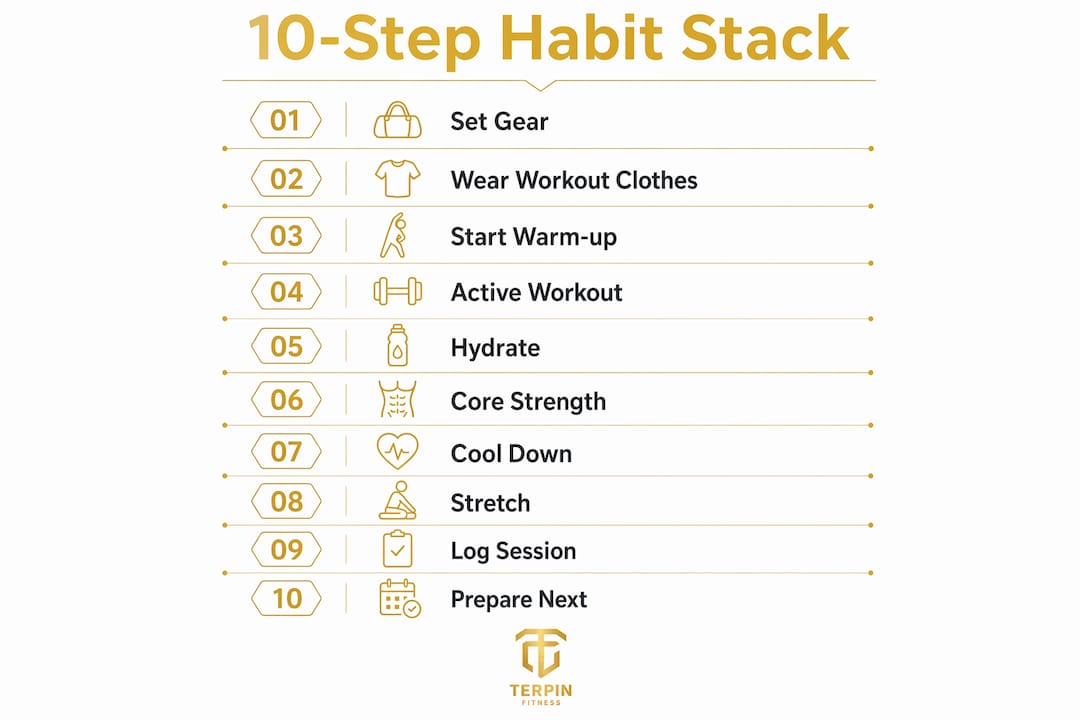
Putting on workout clothes first is the most underrated step in the chain. It applies the “2-minute rule”: make the first action so small that skipping it feels harder than doing it. Once the clothes are on, the rest of the chain follows naturally.
The stack adapts to any setting. Gym workouts slot in Step 6 with barbell or machine work. Home workouts use bodyweight or resistance bands. Outdoor workouts replace the gym with a run or bike ride. The surrounding steps stay identical regardless of location.
Pro Tip: If you miss a day, restart at Step 1 the next morning. Do not try to “make up” missed sessions by doubling up. One clean restart beats two chaotic sessions.
What mistakes kill a fitness habit stack before it forms?
The most common mistake is stacking too many new habits at once. Adding five new behaviors in week one creates a chain that feels like a burden, not a routine. The brain resists complexity. Start with two or three steps and add one new step every one to two weeks.
Vague habits are the second major failure point. “Work out more” is not a habit. “Do 10 pushups after pouring my morning coffee” is a habit. The action must be specific, brief, and measurable. If you cannot describe it in one sentence, it is too complex to stack reliably.
A third pitfall is building a stack around motivation rather than cues. Motivation fluctuates daily. Cues do not. Linking a new habit to an unmissable anchor like brushing teeth or morning coffee removes the dependency on feeling ready. The cue fires, the chain runs, and motivation becomes irrelevant.
Start small. Add one new step per week, not five on day one.
Be specific. Define each habit with a clear action, time, and location.
Use reliable cues. Anchor to habits that happen every single day without exception.
Recover without guilt. Missing a day is not failure; restarting promptly keeps momentum intact.
Track progress. Logging each completed stack reinforces the reward phase of the habit loop.
The 30-day timeline matters here. Research on the structured 10-step approach shows that adherence builds over a 30-day period, not overnight. Expecting the chain to feel automatic in week one sets you up for unnecessary frustration.
How do you customize habit stacking for your lifestyle and goals?
Personalization is what separates a habit stack that lasts from one that collapses in two weeks. The first step is identifying your strongest anchor habit. That is the one daily behavior you never skip, regardless of how busy or tired you feel.
Timing your stack to your energy
Morning stackers tend to attach fitness habits to waking up, making coffee, or showering. Midday stackers link workouts to a lunch break or a work transition. Evening stackers anchor to arriving home, changing clothes, or finishing dinner. None of these is superior. The best timing is the one that matches your natural energy peak.
Scaling up gradually
Simple, brief workouts stacked onto daily anchors prevent the intimidation that kills long-term adherence. Start with a 10-minute session. Add five minutes every two weeks. By week eight, you are doing 30-minute sessions without the psychological weight of a sudden commitment.
Using your environment as a cue
Placing workout gear visibly reduces friction at the moment of decision. Shoes by the door, a resistance band on the desk, or a gym bag packed the night before all serve as physical cues that trigger the chain. Remove the barriers between you and the first step, and the rest follows. For home training setups, a dedicated home workout space reinforces the environmental cue every time you walk past it.
Identify your anchor. Choose one unmissable daily habit as your stack foundation.
Match timing to energy. Morning, midday, or evening: pick the window where you perform best.
Design your environment. Make the first step visible and within arm’s reach.
Build in a reward. A post-workout ritual you enjoy, like a specific playlist or a favorite meal, reinforces the loop.
Scale with ability. Increase duration or intensity only after the current stack feels automatic.
Habit stacking for weight loss follows the same logic. Attach a short walk to lunch, a five-minute stretch to waking up, and a protein-rich meal to post-workout. Each small behavior compounds over weeks into measurable results. Workout consistency is the variable that drives fat loss, not any single session.
Key Takeaways
Habit stacking fitness works because it replaces willpower with automatic behavior chains, making consistent exercise a function of daily structure rather than daily motivation.
Point | Details |
Define the anchor first | Choose one unmissable daily habit as the foundation before adding any fitness steps. |
Start with two or three steps | Adding too many habits at once causes the chain to collapse; build gradually over 30 days. |
Use the 2-minute rule | Make the first step so small that skipping it feels harder than doing it. |
Environment drives behavior | Visible gear and a prepared space reduce friction and trigger the chain automatically. |
Missed days are recoverable | Restarting promptly after a missed session maintains momentum without self-defeat. |
What I’ve learned from building habit stacks with real clients
The theory behind habit stacking is clean and logical. The practice is messier, and that is where most guides stop being useful.
What I have seen working with clients in Pensacola and online is that the anchor habit matters far more than the workout itself. Clients who pick a weak anchor, one they sometimes skip, watch the whole chain fall apart within two weeks. Clients who pick a bulletproof anchor, like their morning coffee or their commute home, build chains that survive vacations, schedule changes, and bad weeks.
The other thing I have noticed is that people underestimate how long the automatic phase takes. The first two weeks feel deliberate and effortful. Weeks three and four start to feel lighter. By week six, most clients report that skipping the stack feels stranger than doing it. That shift is the goal. It does not happen faster by adding more steps.
My honest advice: treat the first 30 days as a construction phase, not a performance phase. You are not trying to get fit in month one. You are trying to build a chain that will get you fit in months two through twelve. Patience in the early phase is not weakness. It is the whole strategy. If you want help building that chain with a plan designed around your schedule, working with a personal trainer accelerates the process significantly.
— Marc
How Terpinfit helps you put habit stacking into practice
Terpinfit works with clients in Pensacola and online to build workout routines grounded in habit stacking principles. Every program starts with identifying your anchor habits, then building a structured stack around your schedule, goals, and current fitness level.

The process is straightforward. You fill out a short inquiry form, and Marc designs a plan that fits your life rather than forcing you to fit a generic program. Whether you train at home, at a gym, or outdoors, the habit stack adapts to your environment. Clients who follow a structured, personalized plan see faster adherence than those working from generic advice alone. Visit the Terpinfit personal training page to get started with a program built around your routine.
FAQ
What is habit stacking in fitness?
Habit stacking in fitness is the practice of linking new exercise behaviors to existing daily habits so workouts become automatic. A 2023 meta-analysis confirmed this approach improves adherence when habits are simple and clearly defined.
How many habits should I stack at once?
Start with two or three habits and add one new step every one to two weeks. Stacking too many habits simultaneously is a leading cause of routine collapse.
Does habit stacking work for weight loss?
Habit stacking supports weight loss by making consistent movement and nutrition behaviors automatic. Small stacked habits like a post-lunch walk or a post-workout protein meal compound into measurable results over weeks.
What is the best anchor habit for a fitness stack?
The best anchor is a daily habit you never skip, such as brewing morning coffee, brushing teeth, or arriving home from work. Linking fitness habits to unmissable anchors removes reliance on motivation.
Does habit stacking work for people with ADHD?
Habit stacking is particularly effective for people with ADHD because it provides predictable structure and reduces the cognitive load of deciding when and how to work out. Structured routines combat forgetfulness and distraction by making the next step automatic.
Recommended
Comments