Types of Fitness Assessments: Your 2026 Guide

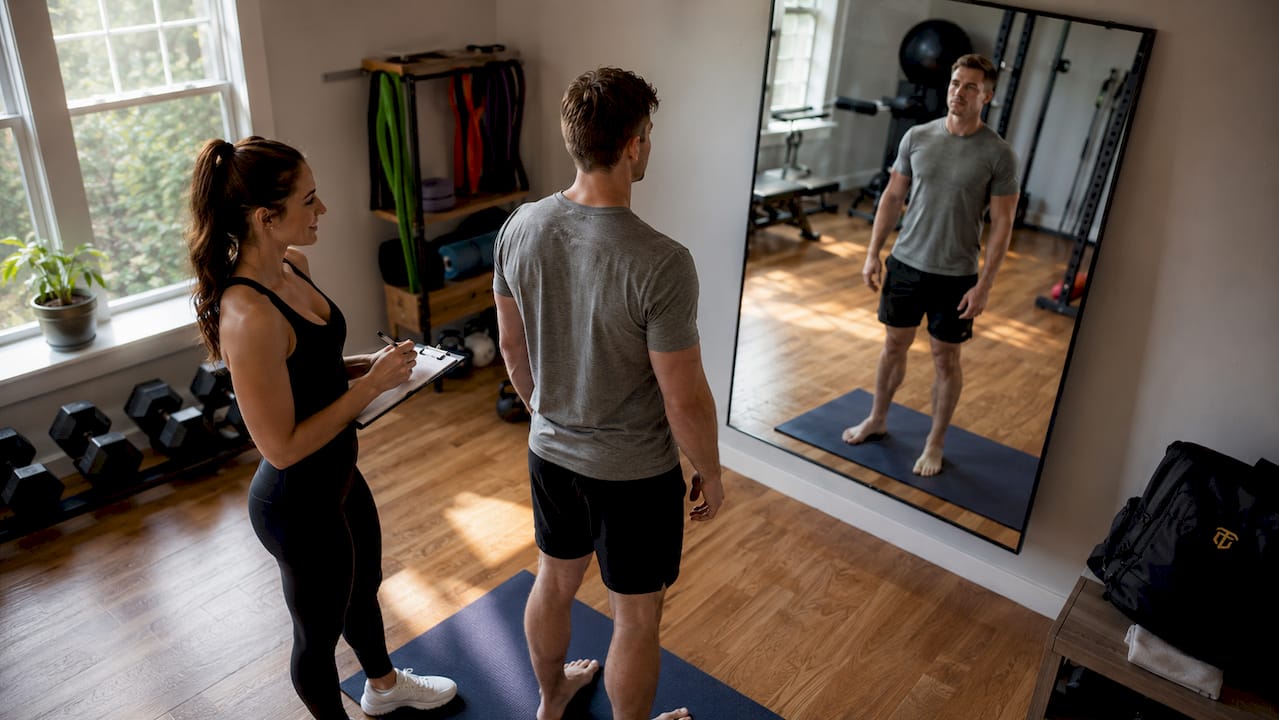
Fitness assessments are structured tests that measure your physical and lifestyle factors to establish a baseline for your personal training program. The four core assessment areas recognized in current industry standards are health and lifestyle, body composition, physical fitness testing, and posture and movement analysis. Together, these types of fitness assessments give you and your trainer a complete picture of where you are and exactly what needs to change. Without that data, your program is just guesswork dressed up as a plan.
1. What are the types of fitness assessments?
Fitness assessments fall into four recognized categories. Each one measures a different dimension of your health, and skipping any of them leaves a gap in your program. Think of them as four lenses on the same subject: your body.
Health and lifestyle: Sleep quality, stress levels, medical history, and daily activity habits
Body composition: The ratio of fat mass to lean mass in your body
Physical fitness testing: Cardiovascular endurance, muscular strength, and muscular endurance
Posture and movement analysis: How your body aligns and moves under load or at rest
Lifestyle factors like sleep and stress directly affect how well you can adhere to an exercise program. A trainer who skips the health and lifestyle screen is building your program on incomplete information.
2. Body composition assessments: what they measure and why they matter

Body composition assessment is the process of determining the percentage of your body that is fat versus lean tissue, including muscle, bone, and water. This tells you far more than a bathroom scale ever could. Two people can weigh exactly the same and have completely different fitness levels.
Common body composition methods include:
BMI (Body Mass Index): A quick ratio of weight to height, useful for population screening but limited for individuals with high muscle mass
Skinfold measurements: Calipers pinch specific sites on your body to estimate subcutaneous fat
Bioelectrical impedance analysis (BIA): A low-level electrical current passes through your body to estimate fat and lean mass
DEXA scan: Dual-energy X-ray absorptiometry, the gold standard for body composition accuracy
Consistent body composition tracking requires using the same equipment and the same time of day every 4–6 weeks. Hydration and food intake cause daily fluctuations that can make your results look worse or better than they actually are.
Pro Tip: Test body composition first thing in the morning, before eating or drinking, and after using the restroom. This gives you the most stable baseline reading every time.
3. How cardiovascular endurance assessments measure your aerobic fitness
Cardiovascular endurance tests measure how efficiently your heart and lungs deliver oxygen to working muscles over time. This is one of the strongest predictors of long-term health. Poor aerobic capacity is linked to higher risk of heart disease, metabolic disorders, and early mortality.
Popular cardiovascular fitness tests include:
Multi-stage fitness test (beep test): You run between two points in time with a recorded beep, with intervals getting shorter as the test progresses
1-mile run or walk test: Measures the time it takes to complete one mile at maximum effort
Step test: You step on and off a platform at a set pace, then measure your heart rate recovery
VO2 max testing: The most precise measure of aerobic capacity, calculated by analyzing oxygen consumption during maximal exercise
VO2 max and lactate testing provide evidence-backed aerobic capacity measures directly linked to longevity benefits. These metrics also help set precise training zones so you are working at the right intensity, not just working hard.
Physical fitness tests like these should be repeated every 8–12 weeks to objectively track aerobic progress. That interval gives your body enough time to adapt before you retest.
4. What muscular strength and endurance tests reveal about your fitness
Muscular strength tests measure the maximum force your muscles can produce in a single effort. Muscular endurance tests measure how long your muscles can sustain repeated contractions. Both matter, and they are not the same thing.
Common strength and endurance tests include:
One-repetition maximum (1RM): The heaviest weight you can lift for one full repetition with good form
Grip strength dynamometry: A handheld device measures the force your hand and forearm can produce, a reliable indicator of overall strength
Push-up test: Counts maximum repetitions with proper form, measuring upper body endurance
Sit-up or curl-up test: Measures core and hip flexor endurance
Plank hold: Timed test of isometric core stability
Bodyweight squat test: Counts repetitions to assess lower body endurance and movement quality
Force production relative to body weight is a more meaningful measure of functional strength than absolute numbers. A 150-pound person who can deadlift 300 pounds is stronger relative to their size than a 250-pound person lifting the same weight.
Pro Tip: Always test muscular strength before endurance in the same session. Fatigue from endurance tests will artificially lower your 1RM results and give you inaccurate data.
5. How posture and movement analysis improves fitness and injury prevention
Posture and movement analysis is the process of observing how your body aligns at rest and how it moves under load. This category is the most overlooked of the four, yet it often reveals the root cause of pain, plateaus, and recurring injuries.
Static postural assessments look at your alignment from the front, side, and back while you stand still. The overhead squat assessment adds a dynamic layer by watching how your joints move together under a light load. Dynamic movement evaluations go further, testing patterns like lunging, hinging, and rotating.
Posture reveals compensation patterns and muscle imbalances that performance tests simply cannot detect. You could score well on a push-up test while silently compensating with your lower back on every rep. Without a movement screen, that compensation goes unaddressed until it becomes an injury.
Advanced tools like force plates and 2D or 3D motion capture systems add precision to movement analysis. These technologies identify asymmetries between your left and right sides, which is information that visual observation alone can miss.
Pro Tip: If you have a history of joint pain or recurring tightness in one area, ask your trainer to prioritize the overhead squat assessment. It often reveals the upstream cause of downstream pain.
6. How to choose and prepare for the right fitness assessments
Choosing the right fitness evaluation types starts with your goal. Someone training for a 5K needs a strong cardiovascular baseline. Someone recovering from a shoulder injury needs a movement screen first. Someone focused on body recomposition needs consistent body composition tracking above all else.
When selecting assessments, consider these factors:
Your primary goal: Fat loss, strength gain, endurance, or injury prevention each point to different priority tests
Your current health status: Medical conditions or recent injuries may rule out certain tests or require modifications
Your training history: Beginners benefit from a full battery of tests; experienced athletes may focus on specific performance markers
Preparation matters as much as the test itself. Avoid tobacco, alcohol, and caffeine for 3–5 hours before your assessment, eat a small meal 1–2 hours prior, and skip vigorous exercise on test day. These steps protect the accuracy of your baseline data.
Wear comfortable, loose clothing and avoid strenuous activity before testing to get valid resting-state metrics for blood pressure and muscular performance.
Assessment type | Recommended frequency | Primary use |
Body composition | Every 4–6 weeks | Track fat loss or muscle gain |
Cardiovascular endurance | Every 8–12 weeks | Monitor aerobic capacity |
Muscular strength and endurance | Every 8–12 weeks | Measure strength progress |
Posture and movement | Every 12–16 weeks | Identify imbalances, reduce injury risk |
Health and lifestyle | At intake and as needed | Adjust program to life factors |
Using identical tests for every client eliminates bias and creates consistent, repeatable coaching. This systemized approach is what separates data-driven training from trial and error.
Key takeaways
The most effective fitness programs are built on all four assessment categories: health and lifestyle, body composition, physical fitness testing, and posture and movement analysis.
Point | Details |
Four core assessment areas | Health and lifestyle, body composition, fitness testing, and posture analysis form the complete picture. |
Test body composition every 4–6 weeks | Use the same equipment and time of day to avoid misleading fluctuations. |
Retest cardiovascular and strength every 8–12 weeks | This interval gives your body time to adapt before you measure progress again. |
Posture screens catch hidden imbalances | Movement analysis reveals compensation patterns that performance tests miss entirely. |
Preparation directly affects accuracy | Avoid stimulants, eat lightly beforehand, and skip hard training on test day. |
What I’ve learned from using every type of fitness assessment
Most people walk into a gym with a goal and skip straight to a program. I get it. Assessments feel like a delay when you are motivated and ready to move. But the clients I have seen make the fastest progress are always the ones who started with a full assessment battery, not just a body weight check.
The part that surprises people most is the posture and movement screen. I have worked with clients who could do 20 pull-ups but had a significant left-to-right hip shift they had never noticed. That asymmetry was loading one side of their lower back on every rep. No amount of cardio or strength testing would have caught it. The movement screen did.
Lifestyle assessments also change the game in ways that are hard to quantify. When I ask about sleep and stress before building a program, I often find out that a client is averaging five hours of sleep a night. Prescribing high-intensity training to someone in that state is counterproductive. The assessment tells me to build recovery into the program first.
The biggest mistake I see is people treating assessments as a one-time event. Your body changes. Your stress levels change. Your sleep changes. Tracking progress consistently is what turns assessment data into a real feedback loop. Without that loop, you are flying blind after the first month.
Assessments are not a judgment of where you are. They are the starting point for where you are going.
— Marc
Terpinfit uses assessments to build your program from day one
Every program at Terpinfit starts with a structured assessment protocol aligned with current industry standards. That means your trainer is not guessing about your starting point or your limitations.
Whether you train in person in Pensacola or work with Terpinfit online, your program is built on real data from body composition, cardiovascular, strength, and movement assessments. Systematic reassessment every few weeks keeps your program current as your fitness changes. If you are ready to train with a clear plan backed by objective data, book your assessment with a Terpinfit trainer today. You can also request a consultation to learn which assessments are right for your goals.
FAQ
What is a fitness assessment?
A fitness assessment is a structured set of tests that measure your physical health, body composition, cardiovascular endurance, muscular fitness, and movement quality. The results establish a baseline and guide your personalized training program.
How often should I get a fitness assessment?
Body composition should be tested every 4–6 weeks, while cardiovascular and strength tests are best repeated every 8–12 weeks. Posture and movement screens are typically reviewed every 12–16 weeks or after a significant program change.
What is the most important type of fitness assessment?
No single assessment type is most important. The four categories work together: body composition tracks physical changes, cardiovascular tests measure heart health, strength tests reveal muscle function, and movement screens catch imbalances that cause injury.
Do I need special equipment for fitness assessments?
Basic assessments like push-up tests, plank holds, and the step test require minimal equipment. More precise methods like DEXA scans, VO2 max testing, and force plate analysis require professional facilities or a certified trainer.
How do I prepare for a fitness assessment?
Avoid caffeine, alcohol, and tobacco for 3–5 hours before testing, eat a light meal 1–2 hours prior, and skip hard training on test day. Wear comfortable clothing and arrive well rested for the most accurate results.
Recommended
Comments