Nutrition Coaching Explained: Your 2026 Beginner's Guide
- terpinfitness
- Jun 23
- 7 min read


Nutrition coaching is a behavioral service where a trained professional partners with you to build sustainable eating habits tailored to your lifestyle and goals. Unlike a registered dietitian, a nutrition coach does not diagnose or treat medical conditions. The focus is on education, accountability, and habit formation rather than clinical prescription or rigid meal plans. If you have ever wondered what is nutrition coaching explained in plain terms, the short answer is this: it is a structured, personalized process that closes the gap between knowing what to eat and actually doing it consistently.
What is nutrition coaching and how does it work?
Nutrition coaching is a non-clinical, behavioral service that translates nutrition science into daily habits you can realistically maintain. A nutrition coach is not a dietitian and does not write medical diet prescriptions. Instead, the coach works with you to identify what is getting in the way of consistent, healthy eating and builds a plan around your actual life.

The coaching process follows a clear cycle: assess, plan, practice, and refine. Most programs begin with a comprehensive intake assessment lasting 30–60 minutes. That session covers your health history, current eating patterns, lifestyle demands, sleep, stress, and your specific goals, whether that is fat loss, more energy, or building muscle.
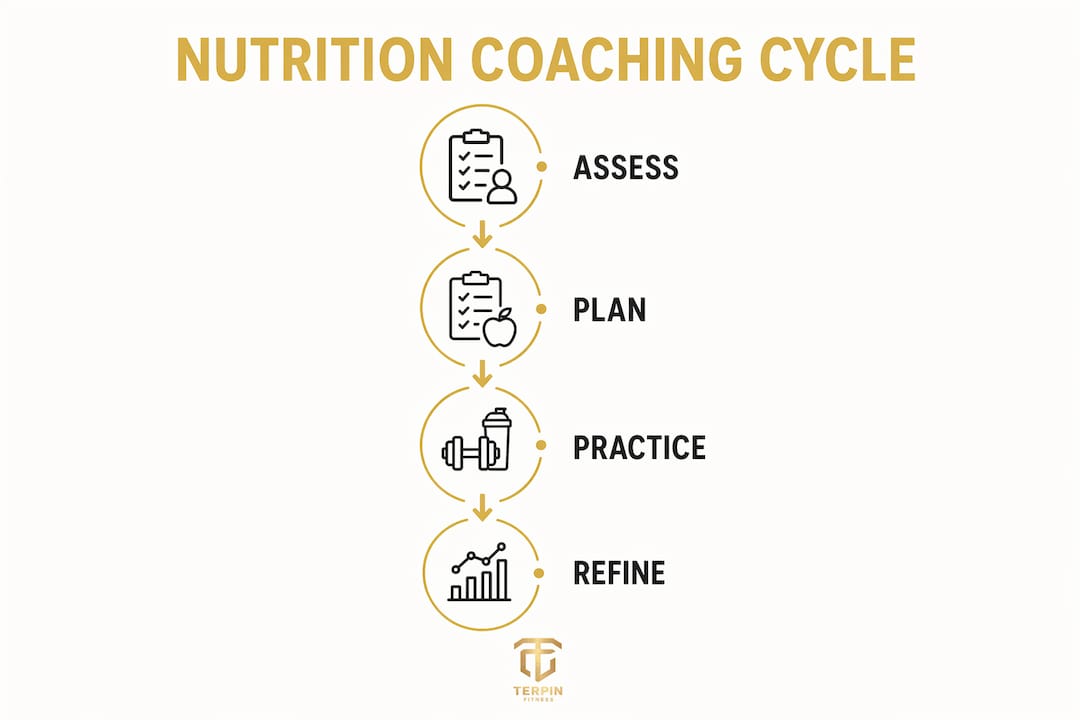
After the intake, the coach and client set realistic, collaborative targets. Weekly or bi-weekly check-ins follow, where the coach reviews what worked, what did not, and adjusts the plan accordingly. This is not a one-size-fits-all program. The plan shifts when your schedule changes, when you travel, or when life gets stressful.
The typical coaching cycle looks like this:
Intake assessment. You share your health history, goals, current diet, and lifestyle factors in a structured conversation.
Collaborative goal-setting. Coach and client agree on specific, realistic targets based on what fits your life, not a generic template.
Habit practice. You implement small, targeted changes between sessions, focusing on one or two behaviors at a time.
Check-in and review. The coach tracks both behavior markers and outcome markers, such as energy levels, sleep quality, and body composition.
Plan refinement. Based on real feedback, the plan adapts. Plateaus, stress, and schedule changes all trigger adjustments.
Pro Tip: Tell your coach about your worst week, not your best one. A plan built around your hardest days is far more durable than one designed for ideal conditions. Learning how to communicate your goals clearly from the start makes every session more productive.
What are the benefits of nutrition coaching vs. self-guided approaches?
The core nutrition coaching benefit is not information. Most people already know vegetables are better than chips. The real value is bridging knowledge with consistent action and overcoming the lifestyle barriers that derail self-guided attempts.
A 2026 study found that personalized nutrition coaching produces statistically significant improvements in BMI, HbA1c, physical activity levels, and dietary fat reduction. Those results held regardless of a person’s starting BMI. That means coaching works across a wide range of starting points, not just for people who are already close to their goals.
Research from the VA also confirms that health coaching improves self-efficacy and reduces calorie intake across diverse populations. Self-efficacy is your belief in your own ability to follow through. That belief is often the missing ingredient when self-guided diets fail.
Nutrition coach vs. nutritionist vs. dietitian
Role | Scope | Regulated? | Best for |
Registered Dietitian | Medical nutrition therapy, disease management | Yes | Chronic conditions, clinical settings |
Nutritionist | General nutrition education (varies by state) | Varies | General wellness guidance |
Nutrition Coach | Behavior change, habit building, accountability | No (certification-based) | Lifestyle improvement, consistency |
Key nutrition coaching benefits at a glance:
Personalized plans built around your schedule, preferences, and goals
Regular accountability that keeps you consistent between sessions
Behavior-focused coaching that addresses emotional and psychological eating patterns
Flexible adjustments when life changes, rather than starting over from scratch
Improved self-efficacy, so you trust your own ability to make good choices
What methods do nutrition coaches use?
Nutrition coaches draw from behavior science, not just food science. Motivational interviewing is one of the most widely used techniques. It is a conversational method where the coach asks open questions that help you articulate your own reasons for change. When the motivation comes from you, adherence is far stronger than when it comes from an external rule.
Goal-setting and problem-solving are the other two pillars of effective coaching. Coaches set specific, short-term targets rather than vague long-term wishes. Problem-solving sessions address real obstacles: late work nights, social dinners, travel, or emotional eating triggers. The coach does not hand you a solution. The coach helps you find one that fits your life.
Habit stacking is a practical tool coaches use to embed new behaviors into existing routines. Instead of adding a new habit from scratch, you attach it to something you already do. Drinking a glass of water before every morning coffee is a simple example. The new behavior piggybacks on an established one, which dramatically reduces the mental effort required.
Common coaching methods and what they address:
Motivational interviewing. Builds internal motivation and client ownership of goals, which predicts long-term adherence far better than external pressure.
Environment design. Coaches help you restructure your kitchen, meal prep routine, and grocery habits so healthy choices become the default.
Habit stacking. New nutrition behaviors attach to existing daily routines, reducing friction and making consistency easier.
Emotional eating work. Coaches address the psychological side of food choices without judgment, helping you recognize triggers and build alternative responses.
Iterative problem-solving. Setbacks are treated as data, not failures. Each obstacle teaches you how to recover without abandoning progress.
Pro Tip: Do not measure progress only on the scale. Objective non-scale markers like energy levels, sleep quality, and workout recovery give a far more complete picture of whether your nutrition is working. These markers keep motivation high during slow weeks.
How to get started with nutrition coaching
Starting nutrition coaching is straightforward, but knowing what to expect from nutrition coaching upfront saves time and sets realistic expectations. The first step is finding a qualified coach with recognized credentials. Look for certifications from organizations like Precision Nutrition, the National Academy of Sports Medicine (NASM), or the International Sports Sciences Association (ISSA).
Steps to get started:
Clarify your goals before the first call. Know whether you want fat loss, more energy, better performance, or general health improvement. Specific goals lead to better plans.
Ask about the coaching format. Options include in-person sessions, online video calls, app-based coaching, or a combination. Online coaching works well for busy schedules.
Expect an honest intake conversation. A good coach asks about your sleep, stress, work schedule, and food preferences, not just your weight.
Set a realistic timeline. Sustainable habit change takes weeks, not days. Most clients see meaningful progress within 8–12 weeks of consistent effort.
Commit to the check-ins. Ongoing check-ins are where the real coaching happens. Skipping them slows progress significantly.
One common misconception is that a nutrition coach will hand you a strict meal plan and expect perfect compliance. The reality is the opposite. The best coaches build systems rather than rigid diets, so you can navigate real life without falling apart every time your routine changes.
Key Takeaways
Nutrition coaching works because it replaces generic diet rules with personalized, behavior-based systems built around your actual life, goals, and barriers.
Point | Details |
Coaching is behavioral, not clinical | Nutrition coaches focus on habit change and accountability, not medical diagnosis or treatment. |
The process is cyclical | Assess, plan, practice, and refine. Plans adapt as your life and goals evolve. |
Evidence supports real results | A 2026 study shows coaching improves BMI, HbA1c, and physical activity independent of starting weight. |
Methods go beyond meal plans | Coaches use motivational interviewing, habit stacking, and environment design to build lasting change. |
Non-scale markers matter | Energy, sleep, and recovery data give a fuller picture of progress than weight alone. |
Why I think most people underestimate what nutrition coaching actually does
Most people walk into nutrition coaching expecting a meal plan. They leave with something more useful: a system for making better decisions under real conditions.
I have seen this pattern repeatedly. A client knows exactly what they should eat. They have read the articles, downloaded the apps, and tried the diets. The problem is never the information. The problem is execution when life gets hard. That is where coaching earns its value.
The clients who get the best results are not the ones who follow the plan perfectly. They are the ones who learn how to recover quickly after a bad week. Nutrition coaching requires iterative problem-solving. Every setback is a lesson in how to do better next time, not a reason to start over.
What I find most underrated is the self-efficacy piece. When a client starts trusting their own judgment around food, the coach becomes less necessary over time. That is the goal. A good coach builds your independence, not your dependence. If you have been stuck in the same cycle of starting and stopping, coaching shortens that loop considerably. It is not magic. It is a structured process that removes the guesswork and replaces it with skills you keep for life.
— Marc
Terpinfit personal training with nutrition coaching built in
Terpinfit works with clients in Pensacola, Florida, and online across the U.S., combining personal training with nutrition coaching in one connected program.
Every client starts with a full intake covering goals, lifestyle, and current habits. From there, Terpinfit builds a plan that fits your schedule, whether you train in person or remotely. Nutrition guidance is woven into the training process, not treated as a separate add-on. If you are ready to work with a coach who addresses both your training and your eating habits, view Terpinfit’s services and submit an inquiry to get started.
FAQ
What is a nutrition coach?
A nutrition coach is a certified professional who helps clients build sustainable eating habits through behavior change, accountability, and personalized goal-setting. Nutrition coaches do not diagnose or treat medical conditions.
How is a nutrition coach different from a dietitian?
A registered dietitian is a licensed medical professional who can treat clinical conditions like diabetes or eating disorders. A nutrition coach focuses on lifestyle habits, behavior change, and consistency for generally healthy individuals.
What does a first nutrition coaching session look like?
The first session is typically a 30–60 minute intake covering your health history, current eating patterns, lifestyle, and goals. The coach uses this information to build a starting plan collaboratively with you.
How long does nutrition coaching take to show results?
Most clients notice meaningful changes in energy, habits, and body composition within 8–12 weeks of consistent coaching. Sustainable results build gradually through repeated behavior, not rapid restriction.
Can nutrition coaching work online?
Online nutrition coaching is fully effective and widely used. Video check-ins, app-based tracking, and messaging between sessions replicate the structure of in-person coaching for clients anywhere in the U.S.
Recommended
Comments