How to Build an Accountability Fitness Routine That Sticks
- terpinfitness
- Jun 22
- 8 min read


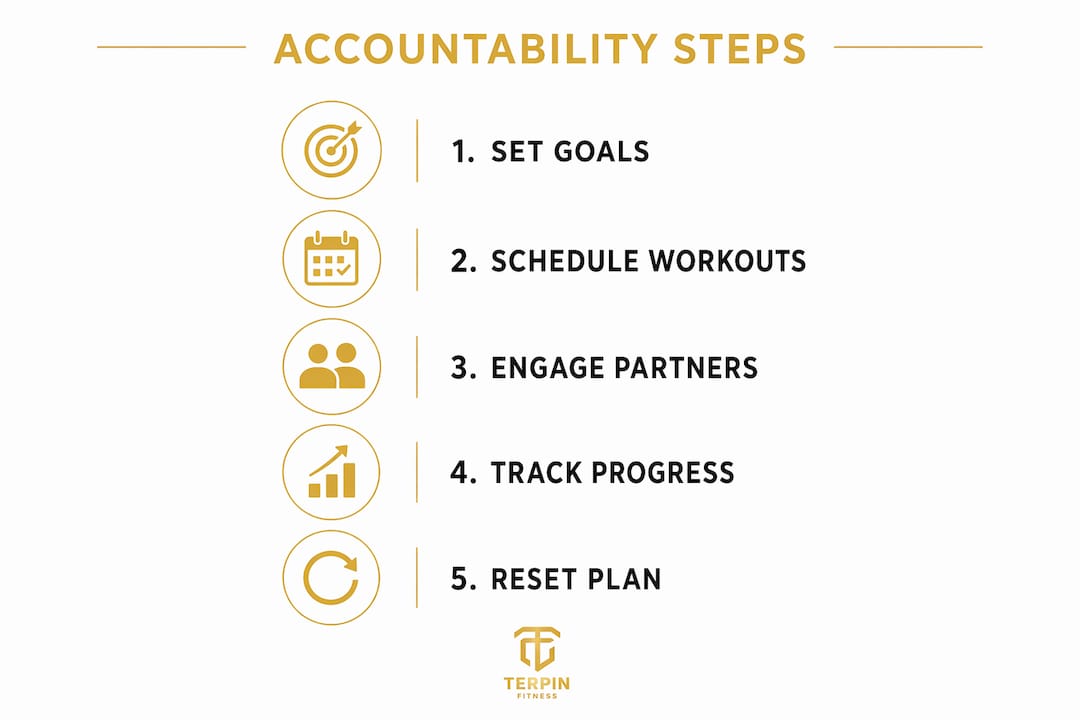
Fitness accountability is defined as the structures, habits, and relationships that keep you following through on your exercise plan, even when motivation fades. Building an accountability fitness routine means combining goal setting, scheduled workouts, social support, and progress tracking into one system that works for your life. Without these elements working together, most people rely on willpower alone, which runs out fast. The strategies in this article are grounded in current research and the practical experience of Terpinfit Personal Training Pensacola, an online and in-person personal training service based in Pensacola, Florida.
How to build an accountability fitness routine with clear goals
Accountability starts before you ever set foot in the gym. The first step is writing down specific, measurable goals using the SMART framework: Specific, Measurable, Achievable, Relevant, and Time-bound. A goal like “lose weight” gives you nothing to track. A goal like “complete three workouts per week for the next eight weeks” gives you a clear pass or fail each week.
Fitness routine goal setting works best when you separate behavior goals from outcome goals. A behavior goal is something you control directly, like showing up to the gym on monday, wednesday, and friday. An outcome goal is the result you want, like losing 10 pounds. Behavior goals drive accountability because you can measure them daily.
Writing goals down and sharing them with someone else adds a second layer of accountability. Communicating your goals to a coach or training partner creates a social contract that raises your follow-through rate. Fitness journals, apps like MyFitnessPal, or even a simple notes app on your phone all work for documentation.
Key steps for effective fitness routine goal setting:
Write at least one behavior goal and one outcome goal
Set a specific review date, such as every four weeks
Share your goals with at least one other person
Align goals with activities you genuinely enjoy to sustain motivation
Keep goals realistic for your current schedule and fitness level
Pro Tip: Align your goals with your personal interests. If you hate running, build your cardio around cycling or swimming. You will stick with what you actually like doing.
How to design a workout schedule that builds lasting habits
Scheduling specific workout days is one of the most effective behavior-change mechanisms for building exercise habits. UCLA Health recommends committing to exact days and starting at low intensity to reduce injury risk and prevent early burnout. The schedule itself becomes the accountability system, not your mood on any given morning. Personal Trainer Pensacola, an online and in-person personal training service based in Pensacola, Florida

Practitioners advise setting accountability standards first, meaning you decide when and how often you will work out before you choose what exercises to do. This order matters. When you decide the workout details first, you end up renegotiating your schedule every week. When you lock in the schedule first, the details fill in around it.
A practical approach to establishing a workout schedule:
Set your minimum standard. Commit to 2–3 workouts per week as your non-negotiable floor. This is achievable even during busy weeks and keeps momentum alive.
Block time on your calendar. Treat workouts like medical appointments. Put them in Google Calendar, Apple Calendar, or a physical planner with a specific start and end time.
Build a fallback plan. If your scheduled 60-minute session is impossible, have a 20-minute backup ready. A short workout beats no workout every time.
Include program variety. The Hospital for Special Surgery, citing ACSM guidance, recommends a balanced program with cardio, strength, and mobility for beginners targeting weight loss and sustained fitness.
Start slow and build gradually. Consistency matters more than intensity early on. UCLA Health emphasizes that starting low and going slow prevents discouragement and reduces injury risk.
Pro Tip: Use a physical planner or a calendar app with color coding. Seeing your workouts as visual blocks makes it harder to mentally erase them when life gets busy.
How do social connections improve fitness accountability?
Social support is one of the most powerful tools for staying accountable in fitness, but the mechanism matters. A 2026 Frontiers study found that social support improves adherence primarily by increasing self-efficacy, meaning your belief in your own ability to succeed. Accountability partners who celebrate your progress build confidence. Partners who only check in when you fail create pressure without results.
Group accountability workouts add a scheduling layer that solo training lacks. When someone else is expecting you at 6 a.m., you show up. Fitness classes, running clubs, and small group training sessions all use this social contract. The key is choosing people whose schedules and goals are compatible with yours.
Digital tools extend social accountability beyond in-person groups. A 2026 JMIR pilot study found that participants who used social comparison features in wearable activity trackers increased their weekly physical activity by 126 minutes on average. That is a meaningful gain from simply seeing how your activity compares to a friend’s on a device you already own.
A 2026 JMIR systematic review also found that social support and self-monitoring are the most effective behavior change techniques in digital health programs. Apps that combine both features, such as those with friend leaderboards and personal progress logs, outperform apps that rely on reminders alone.
Tips for building a support system that actually works:
Choose accountability partners who encourage competence, not just compliance
Use wearable social features intentionally, not passively
Join a fitness group or class with a consistent schedule
Check in with your partner using specific questions, not vague ones
Pro Tip: Ask your accountability partner to confirm completed workouts, not just intentions. “Did you finish Tuesday’s session?” is more effective than “How’s it going?” Specific check-in methods drive far better follow-through than open-ended conversations.
What is the best way to track fitness progress?
Tracking progress closes the feedback loop that keeps your accountability system honest. Without measurement, you cannot tell if your routine is working or if it needs adjustment. The most useful metrics to track are workout attendance, strength improvements, body measurements, and quality-of-life markers like sleep and energy levels.
Simple tracking beats complex tracking every time. A notebook where you log the date, exercises, sets, and reps takes two minutes per session and gives you a clear record. Apps like Strong, Fitbod, or a basic spreadsheet work equally well. The format matters less than the consistency of use.
Tracking method | Best for | Frequency |
Workout journal | Attendance and strength gains | Every session |
Body measurements | Weight loss progress | Every 2–4 weeks |
Fitness app log | Exercise variety and volume | Every session |
Coach check-ins | Accountability and program adjustments | Every 4 weeks |
Progress photos | Visual body composition changes | Every 4–8 weeks |
Review your progress every 8–12 weeks to decide if your routine needs adjustment. This window is long enough to see real trends and short enough to catch problems before they derail your goals. A workout app can automate much of this tracking and surface patterns you might miss on your own.
How do you recover from accountability setbacks?
Missing workouts is not a failure of character. It is a normal part of any fitness routine, and how you respond to a missed session matters far more than the miss itself. The biggest mistake people make is treating one skipped workout as permission to abandon the whole plan.
The fastest recovery strategy is returning to your minimum standard immediately. If you missed monday’s session, show up wednesday. Do not try to make up the lost workout with extra volume. That approach leads to soreness, fatigue, and another missed session.
Common accountability pitfalls and how to fix them:
Vague check-ins: Replace “How’s it going?” with “Did you complete your three sessions this week?”
All-or-nothing thinking: A 20-minute workout counts. Partial effort beats zero effort.
Motivation dependence: Schedule workouts for times when you are typically energized, not when you hope to feel motivated.
Burnout from overcommitting: Start with two workouts per week if three feels like too much. Build from there.
Losing sight of progress: Review your tracking log monthly to remind yourself how far you have come.
Pro Tip: Write a short “reset protocol” at the start of your fitness plan. Decide in advance what you will do after a missed week. Having a written plan removes the guilt and gets you back on track faster.
Key Takeaways
Building a fitness accountability routine requires combining scheduled workouts, specific goals, social support, and regular progress tracking into one consistent system.
Point | Details |
Set behavior goals first | Write specific, measurable goals like workout frequency before focusing on outcome goals like weight loss. |
Lock in your schedule early | Decide when and how often you train before choosing exercises to prevent weekly renegotiation. |
Use social support strategically | Choose partners who build your confidence, and use wearable social features intentionally for best results. |
Track attendance and strength | Log every session and review progress every 8–12 weeks to keep your routine effective and adaptive. |
Recover fast after setbacks | Return to your minimum standard immediately after a missed week rather than trying to compensate with extra volume. |
What I have learned about accountability after years of coaching
Most people come to me thinking they have a motivation problem. After years of working with clients at Terpinfit, I can tell you the real issue is almost always a structure problem. Motivation is unreliable. Structure is not.
The clients who make the most consistent progress are not the most disciplined people in the room. They are the ones who built a system that works even on their worst days. They have a minimum standard, a fallback workout, and at least one person who knows their schedule.
I have also seen how damaging guilt-based accountability can be. When a client misses a session and feels ashamed, they are more likely to avoid the gym the following week, not less. The accountability systems I build with clients focus on celebrating what they did complete, not punishing what they missed. That shift alone changes everything.
One more thing: do not wait until your routine is perfect to start tracking. The data from your first imperfect weeks is the most valuable data you will ever collect. It shows you exactly where your plan needs to flex.
— Marc
Personal training at Terpinfit can build your accountability system
Knowing the principles is one thing. Having a coach who applies them to your specific schedule, goals, and lifestyle is another.

Terpinfit offers both online and in-person personal training in Pensacola, Florida, with programs built around the accountability strategies covered in this article. That means scheduled check-ins, progress tracking, goal reviews, and a coach who knows your plan and holds you to it. Whether you are just starting out or rebuilding after a setback, the personal training services at Terpinfit are designed to give your routine the structure it needs to last. You can also explore the Terpinfit fitness blog for ongoing tips on motivation, scheduling, and building habits that stick.
FAQ
What does fitness accountability actually mean?
Fitness accountability is the combination of goals, schedules, social support, and tracking systems that keep you following through on your exercise plan. It replaces reliance on daily motivation with reliable structure.
How many workouts per week builds real accountability?
A minimum of 2–3 workouts per week is the recommended standard for building consistent accountability, even during busy weeks. Starting at this level keeps momentum without risking burnout.
Do accountability partners actually help with fitness?
Yes. Research shows social support improves exercise adherence by increasing self-efficacy, not just social pressure. Partners who celebrate progress and confirm completed workouts produce better results than those who only check in after missed sessions.
What should I track to stay accountable in my fitness routine?
Track workout attendance, strength improvements, and body measurements at minimum. Review your data every 8–12 weeks to spot trends and adjust your program before small problems become big ones.
How do I get back on track after missing workouts?
Return to your minimum workout standard immediately without trying to make up lost sessions. One missed week does not erase your progress. Returning quickly is the only reset that matters.
Recommended
Comments