How to Assess Your Fitness Level at Home

A fitness assessment is a structured set of physical tests that measures your aerobic endurance, muscular strength, flexibility, and balance. You can assess your current fitness level at home without a gym or expensive equipment. The right tests give you a clear picture of where you stand and what to work on first. That clarity is the foundation of any workout plan that actually works.
How to assess your current fitness level at home
A complete fitness evaluation covers four domains: aerobic endurance, muscular strength, flexibility, and balance. Skipping any one of them leaves you with an incomplete picture. Medical experts confirm that balanced evaluation across all four prevents incomplete fitness profiles and reduces injury risk. Each domain tells you something different about your health and physical readiness.
Self-reported questionnaires can approximate your fitness level, but online questionnaires cannot replace physical performance tests. Movement-based tests capture functional data that no survey can replicate. That is why the tests in this guide focus on what your body actually does, not what you think it can do.
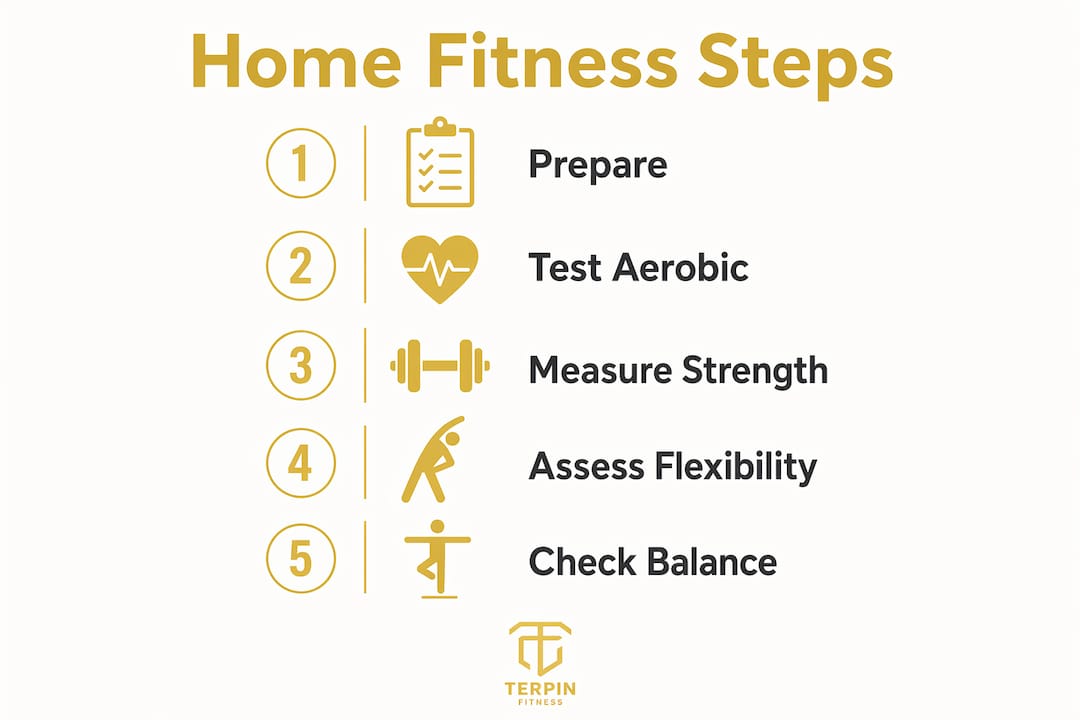
What do you need before starting a home fitness assessment?
Preparation determines whether your results are accurate or misleading. Test on a day when you feel rested and have no significant muscle soreness. Fitness self-assessments are unreliable when performed while fatigued, so schedule your session after a good night of sleep.
Start with a 3–5 minute warm-up walking in place before any test. This improves accuracy and prevents injury. Wear comfortable, non-restrictive clothing and supportive athletic shoes.
Gather these items before you begin:
A stopwatch or smartphone timer
A sturdy, armless chair (seat height around 17 inches)
A measuring tape or digital tape measure
A flat, non-slip surface
A yoga mat or folded blanket for floor tests
A wall for balance support if needed
Pro Tip: Set up all your equipment in one spot before you start. Scrambling between tests raises your heart rate and skews your results.
Optional tools worth having include a smartphone app for timing, a Bluetooth-enabled digital tape measure, or a 3D body scanning app. These add precision and make tracking progress much easier over time. More on those in the technology section below.
How do you perform the key fitness tests at home?
Run each test three times and record your best result. Repeating tests three times controls for variability caused by initial stiffness or nerves. This best-of-three approach is standard practice in reliable self-assessment protocols.
Aerobic endurance: the 1-mile walk test
Walk one mile as briskly as you can without running. Record your time and check your heart rate immediately after finishing. A lower heart rate at the same pace over repeated tests means your cardiovascular fitness is improving. Use a measured track, a treadmill, or map a flat route with a walking app.
Muscular strength and endurance
30-second chair stand test: Sit in the center of a chair with your arms crossed over your chest. Stand fully upright, then sit back down. Count how many complete stands you complete in 30 seconds. This test measures lower body strength and is one of the most predictive markers of functional health.
Push-up test: Perform as many push-ups as possible with proper form before stopping. Men use a standard push-up position. Women may use a modified knee position. Stop when your form breaks, not when it gets hard.
Squat test: Stand with feet shoulder-width apart. Lower into a squat until your thighs are parallel to the floor, then return to standing. Count how many you complete in 60 seconds with controlled form.
Flexibility: sit-and-reach test
Sit on the floor with your legs straight and feet flat against a wall or box. Reach forward as far as possible with both hands and hold for two seconds. Measure the distance from your fingertips to the wall. Limited reach signals tight hamstrings and lower back, which raises injury risk during exercise.
Balance: one-legged stance test
Stand near a wall for safety. Lift one foot off the ground and hold the position as long as possible without touching down. Time each side separately. Standing on one leg for at least 10 seconds correlates with reduced mortality risk. Balance declines faster with age than almost any other fitness quality, which makes this test more important than most people realize.
Pro Tip: Do the balance test last. Fatigue from strength tests will affect your balance, so testing it fresh gives you a cleaner baseline.
Common mistakes to avoid:
Rushing through reps to inflate your score
Holding your breath during strength tests
Testing when sore from a recent hard workout
Skipping the warm-up to save time
Recording your first attempt instead of your best
How do you interpret your home fitness assessment results?
Your scores only matter when you compare them to established benchmarks. The 30-second chair stand test is one of the clearest examples. Fewer than four chair stands in 30 seconds is linked to a threefold higher mortality risk in adults with COPD. That finding underscores how directly functional strength connects to long-term health outcomes.
For the balance test, the 10-second threshold on one leg is the key marker. Falling below it signals a meaningful decline in stability and injury prevention capacity. For flexibility, reaching past your feet on the sit-and-reach test is a solid baseline for adults under 50.
Use your results to set specific, realistic goals:
If your chair stands are low, prioritize lower body strength training two to three times per week.
If your push-up count is below average for your age group, add upper body pressing exercises to your routine.
If your balance score is weak, add single-leg exercises and stability work daily.
If your flexibility score is poor, add 10 minutes of targeted stretching after every workout.
A common mistake is comparing your scores to elite athletes or people decades younger. Compare your results to age-matched benchmarks from sources like the Mayo Clinic or AARP. Then compare your next test to your own previous score. Progress against yourself is the only metric that matters for personal goal setting. You can find a deeper breakdown of how to track fitness progress accurately using both tests and measurements over time.
What home fitness measurement tools improve accuracy?
Technology has made self-assessment more precise than ever. Digital tape measures are the clearest upgrade from traditional tools. Smart tape measures achieve ±3mm accuracy and can track up to 12 body parts independently. That level of precision reveals body composition changes that a bathroom scale completely misses.
3D body scanning apps take this further. These apps use your smartphone camera to generate a full-body model and track changes in shape over time. Tracking body changes through 3D scanning improves motivation even when the scale weight stays flat. Seeing your waist shrink or your shoulders broaden keeps you consistent when numbers alone feel discouraging.
The practical case for digital tools comes down to one problem: people quit when they see no progress. Using precise digital measurements instead of a scale counters premature quitting caused by stationary weight despite real body composition improvements. Muscle gain and fat loss can happen simultaneously while your weight stays the same. A tape measure or 3D scan shows the truth.
The best approach combines manual tests with digital measurement tools. Run your physical performance tests every four to six weeks. Take body measurements every two weeks. Use both data sets together to adjust your training. When you need to go deeper on home workout equipment that supports your post-assessment training, that resource covers the practical options worth investing in.
One honest limitation: home tools cannot fully replace a professional assessment. A certified trainer can observe movement quality, identify compensation patterns, and catch risks that no app or tape measure will flag. Use home assessments as your ongoing tracking system, and schedule a professional evaluation when you hit a plateau or start a significantly new program.
Key Takeaways
A complete home fitness assessment covers aerobic endurance, muscular strength, flexibility, and balance, and combining physical tests with digital measurement tools gives you the most accurate and motivating picture of your health.
Point | Details |
Test all four fitness domains | Aerobic endurance, strength, flexibility, and balance each reveal different health risks. |
Prepare and warm up first | Test on a rested day after a 3–5 minute warm-up to get accurate, injury-free results. |
Use best-of-three scoring | Run each test three times and record your best result to control for variability. |
Know the critical benchmarks | Fewer than four chair stands in 30 seconds and less than 10 seconds on one leg signal elevated health risk. |
Add digital tools for precision | Smart tape measures and 3D scanning apps reveal body composition changes a scale cannot show. |
Why I think most people assess their fitness the wrong way
Most people I work with make the same mistake when they first try to evaluate their fitness. They test themselves right after a hard week of training, feel terrible about their scores, and decide they are worse off than they thought. The problem is not their fitness. The problem is the timing.
Testing on a fatigued body is like checking your car’s fuel gauge right after a long highway drive and concluding the tank is always empty. Your results on a rested day will consistently outperform results taken when you are sore or sleep-deprived. That gap is not small. I have seen people score 30% better on the chair stand test simply by testing on a fresh day versus a tired one.
The other thing I push hard on is the balance test. People skip it because it feels less “serious” than push-ups or a mile walk. That is a mistake. Balance is the fitness quality that declines fastest with age, and it is the one most directly tied to injury prevention and long-term independence. A person who cannot stand on one leg for 10 seconds is at real risk, regardless of how strong or lean they are.
My honest advice: treat your assessment like a workout. Schedule it. Prepare for it. Take it seriously. Then use the data to build a plan you can actually follow. Pair your results with a consistent accountability routine and your scores will improve faster than you expect.
— Marc
Terpinfit personal training for your fitness goals
Self-assessment gives you the data. A personal trainer gives you the plan to act on it.
Terpinfit offers both online and in-person personal training in Pensacola built around your actual fitness level, not a generic program. Once you know your scores, a Terpinfit coach can turn those numbers into a structured, progressive training plan that targets your weakest areas first. Whether you are starting from scratch or refining an existing routine, professional guidance closes the gap between knowing your numbers and actually improving them. Visit the services and inquiry page to get started.
FAQ
How often should I self-assess my fitness at home?
Repeat your full fitness assessment every four to six weeks. This interval gives your body enough time to show measurable improvement between tests.
Can I assess my fitness level at home without any equipment?
Yes. The chair stand, push-up, one-legged stance, and sit-and-reach tests require only a chair, a flat floor, and a timer. A measuring tape adds precision but is not required to start.
What does a low chair stand score mean for my health?
Fewer than four chair stands in 30 seconds is linked to a significantly higher mortality risk in adults. It signals weak lower body strength and is a priority area to address through targeted training.
Is the one-legged balance test really that important?
Balance declines faster with age than almost any other fitness quality. Standing on one leg for at least 10 seconds correlates with reduced mortality risk, making it one of the most health-relevant tests you can do at home.
Why does my weight stay the same even when I feel fitter?
Muscle gain and fat loss can happen at the same time, leaving your scale weight unchanged. Digital tape measures and 3D body scanning apps reveal these body composition shifts when the scale shows no movement.
Recommended
Comments