EMOM Workout Explained: Benefits, Tips, and Examples


An EMOM workout is defined as a training format where you perform a set number of reps at the start of every minute, then rest for whatever time remains before the next minute begins. The acronym stands for Every Minute on the Minute. This structure creates a built-in work-to-rest ratio that keeps your effort honest and your pacing consistent. Terpinfit coaches use EMOM training with both beginners and advanced athletes in Pensacola because it delivers real results without requiring complex equipment or lengthy sessions.
What is an EMOM workout and how does it work?
EMOM training is built on one simple rule: the clock governs your rest. You start your reps when the minute begins. When you finish, you rest until the next minute starts, then you go again. That cycle repeats for the full session length, typically 10–20 minutes.
The ideal work window sits at 30–40 seconds per minute. If your reps take 20 seconds, you get 40 seconds of rest. If they creep past 45 seconds, your rest shrinks to almost nothing, and fatigue compounds fast. Hitting that window consistently is the whole game.

Pacing is not optional in an EMOM. The clock starts regardless of whether you feel ready, which forces you to pick a rep count you can actually sustain. That built-in pressure is what separates EMOM from casual interval training where you rest “whenever it feels right.”
A standard beginner session runs 10 minutes. Intermediate athletes often work in the 15–20 minute range. Advanced formats can push to 30 minutes or longer, depending on the goal. Rep schemes vary widely, from 5 heavy barbell squats per minute to 15 kettlebell swings per minute for conditioning.
Pro Tip: Set a timer app or use a gym clock with a loud beep. Watching a countdown display while mid-set breaks your focus. Hearing the beep keeps your eyes on form.
What are the benefits of EMOM workouts?
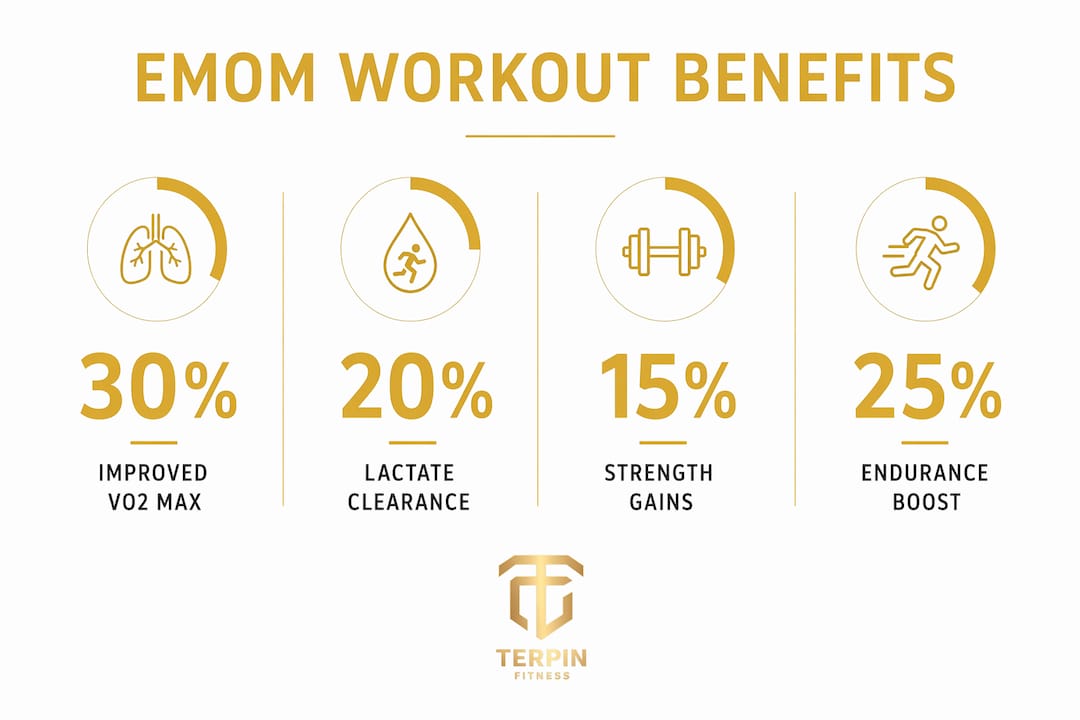
EMOM workouts build both aerobic and anaerobic capacity more effectively than traditional steady-state cardio. That means your heart, lungs, and muscles all get challenged in a single session. Few other formats deliver that combination this efficiently.
The core benefits break down clearly:
Time efficiency. High-volume EMOM sessions accumulate 100–200+ reps within 15–20 minutes. That output rivals much longer traditional workouts.
Self-regulating pacing. The format prevents you from going out too hot. You learn quickly that unsustainable effort means no rest, which teaches discipline faster than any coach cue.
Scalability. Beginners can use bodyweight movements and short durations. Advanced athletes can load barbells and extend sessions. The format fits everyone.
Reduced decision fatigue. EMOM eliminates guesswork about rest timing, so your mental energy goes entirely toward execution and form.
Measurable progress. You can track reps completed per round, total rounds finished, and how your rest window changes over weeks.
“The magic of EMOM lies in the enforced pacing, creating a sustainable rhythm that protects against burnout and fosters consistent output.” — 12 Fitness Blog
EMOM also improves VO2 max and lactate clearance simultaneously, two markers that reflect your body’s ability to work hard and recover fast. Improving both at once is the hallmark of serious conditioning work. Most gym-goers spend months chasing those gains through separate cardio and lifting sessions. EMOM compresses that into one format.
How to design and do EMOM workouts for your goals
Designing a solid EMOM starts with choosing the right exercises. Compound movements like squats, deadlifts, pull-ups, and push-ups deliver the most return per rep. Isolation exercises like bicep curls can work in an EMOM, but they rarely challenge your conditioning enough to justify the format.
Follow this process to build your first EMOM:
Pick one to three exercises. Single-exercise EMOMs are best for beginners. Multi-exercise formats, where you alternate movements each minute, suit intermediate and advanced trainees.
Set your rep count. Test your chosen reps in a single set. If it takes you under 20 seconds, add reps. If it takes over 40 seconds, cut reps. Target that 30–40 second work window.
Choose your session length. Start at 10 minutes if you are new to EMOM. Add 2–3 minutes per week as your conditioning improves.
Scale the load. Use bodyweight or light resistance bands at first. Add weight only when you can complete every round with clean form and still have 15+ seconds of rest.
Track every round. Note which rounds felt easy and which rounds cut into your rest. That data tells you exactly where to adjust.
Here is a comparison of EMOM structures by fitness level:
Level | Exercise example | Reps per minute | Session length |
Beginner | Bodyweight squats | 10 | 10 minutes |
Intermediate | Kettlebell swings | 12–15 | 15 minutes |
Advanced | Barbell power cleans | 5–6 | 20 minutes |
Advanced (benchmark) | Pull-ups (Death By format) | Add 1 rep each minute | Until failure |
The “Death By” format deserves special mention. You start with 1 rep in minute one, 2 reps in minute two, and so on until you can no longer complete the required reps within the minute. Death By EMOMs measure monthly progress precisely by counting how many rounds you complete. Increasing that number month to month gives you a clear, quantifiable fitness benchmark.
Pro Tip: For a beginner-friendly full-body EMOM, try this: minute 1 is 10 push-ups, minute 2 is 15 air squats, minute 3 is 10 ring rows. Repeat that three-minute cycle four times for a 12-minute session.
Common EMOM mistakes and how to avoid them
The most common EMOM mistake is choosing too many reps. Selecting excessive reps causes form breakdown as fatigue builds across rounds. You might complete rounds one through five cleanly, then rounds six through ten become a grind that risks injury. Cap your reps before that happens.
Watch for these pitfalls:
Skipping rest. If you finish your reps and immediately start moving around, you are wasting your recovery window. Sit down, breathe, and let your heart rate drop.
Ignoring form deterioration. Cumulative fatigue must be managed by reducing reps or stopping the session when technique breaks down. Pushing through bad form in an EMOM compounds the problem every minute.
Choosing movements you have not practiced. An EMOM is not the place to learn a new skill. Master the movement first, then put it in an EMOM.
Progressing too fast. Adding reps, load, or session length all at once overloads your recovery. Change one variable at a time.
Use your rest window as a diagnostic tool. If you consistently have less than 10 seconds of rest by the midpoint of your session, your rep count is too high. Drop it by two reps and rebuild. Tracking your workout app data across sessions makes this pattern obvious within two to three weeks.
Pro Tip: Record your finish time for each round. If round one takes 28 seconds and round ten takes 52 seconds, your reps are too high. A well-designed EMOM should show no more than a 10-second drift from your fastest to slowest round.
Key Takeaways
EMOM workouts build strength, endurance, and conditioning simultaneously by using a timed work-rest structure that forces sustainable pacing and measurable output every session.
Point | Details |
Core mechanic | Perform reps at the minute start, then rest until the next minute begins. |
Ideal work window | Target 30–40 seconds of work per minute to preserve form and recovery. |
Scalability | Adjust reps, movements, and duration to suit any fitness level from beginner to advanced. |
Progress tracking | Use Death By EMOMs monthly to quantify conditioning gains with a clear round count. |
Top mistake to avoid | Choosing too many reps causes form breakdown; cap intensity before fatigue compounds. |
Why EMOM is the format I keep coming back to
I have programmed a lot of training formats over the years. Straight sets, supersets, circuit training, Tabata, you name it. EMOM is the one I return to most often, and not just because clients respond well to it. I return to it because it is honest.
Most people do not realize how much they cheat their rest in traditional training. They rest two minutes, then check their phone, then rest another 90 seconds, then chat with someone. EMOM removes all of that. The clock is the coach. That accountability is worth more than any fancy program design.
What surprises people most is how beginner-friendly EMOM actually is. Most beginners assume it is a CrossFit-level format reserved for athletes. It is not. A 10-minute bodyweight EMOM with air squats and push-ups is genuinely accessible to someone who has never trained before. The format scales down just as well as it scales up.
The mental side is underrated too. Finishing a 20-minute EMOM where every round was clean builds a kind of confidence that random gym sessions do not. You have proof, right there in your notes, that you held your pace for 20 straight minutes. That matters. If you want to communicate those goals clearly to a trainer, EMOM data gives you something concrete to work from.
— Marc
Ready to build your EMOM program with Terpinfit?
Knowing the format is one thing. Building a program that actually fits your schedule, your current fitness level, and your long-term goals is another. Terpinfit offers both in-person training in Pensacola, Florida and online personal training for clients across the U.S. Every program is built around your specific needs, not a generic template.

Whether you want a 10-minute beginner EMOM or a full conditioning block built around advanced formats, Terpinfit designs it with you. Visit the Terpinfit services page to start a conversation about your training. The first step is just telling us where you are and where you want to go.
FAQ
What does EMOM stand for in fitness?
EMOM stands for Every Minute on the Minute. You perform a set number of reps at the start of each minute, then rest for the remainder before repeating.
How long should a beginner EMOM workout be?
Beginners should start with 10 minutes. As conditioning improves, session length can increase by 2–3 minutes per week up to 20 minutes or more.
What are the best exercises for an EMOM workout?
Compound movements like squats, push-ups, kettlebell swings, and pull-ups work best. They challenge multiple muscle groups and generate enough demand to make the work-rest structure meaningful.
How do I know if my EMOM rep count is too high?
If your finish time drifts more than 10 seconds from your fastest round to your slowest, or if your rest window drops below 10 seconds, reduce your reps by two and rebuild from there.
Can EMOM workouts replace cardio?
EMOM training builds both aerobic and anaerobic capacity, which means it can replace traditional steady-state cardio for many people. The fixed work-rest interval structure delivers conditioning benefits that match or exceed longer cardio sessions.
Recommended
Comments