Compound Exercises Explained: A Beginner's Strength Guide


Compound exercises are defined as multi-joint movements that activate two or more muscle groups at the same time. The squat, deadlift, bench press, and pull-up are the clearest examples. These movements form the foundation of every effective strength training program, and fitness experts consistently recommend them as the primary tool for building strength and muscle. Experts recommend an 80/20 training ratio with 80% compound exercises and 20% isolation exercises for beginners through early intermediates. That ratio reflects how much more work compound movements accomplish per set compared to single-muscle exercises.
What are compound exercises, and why do they matter?
Compound exercises are multi-joint movements that recruit several muscle groups within a single rep. A squat, for example, loads the quadriceps, hamstrings, glutes, and spinal erectors simultaneously. That is fundamentally different from a leg extension machine, which isolates only the quadriceps.

The term “compound exercise” is the recognized industry standard. You will also hear coaches use the phrase “multi-joint movement” or “compound lift,” and all three terms describe the same concept. The opposite category is the isolation exercise, sometimes called a “single-joint movement,” which targets one muscle group through one joint.
Compound movements are the backbone of programs like Starting Strength, StrongLifts 5x5, and German Volume Training. Each of those programs centers on the squat, deadlift, bench press, overhead press, and row because those five movements cover every major muscle group in the body. Pattern-based programming over equipment preference reduces injury risk and improves long-term training consistency. That means you can perform a compound push pattern with a barbell, dumbbells, or even a push-up and get comparable results.
What are the primary benefits of compound exercises?
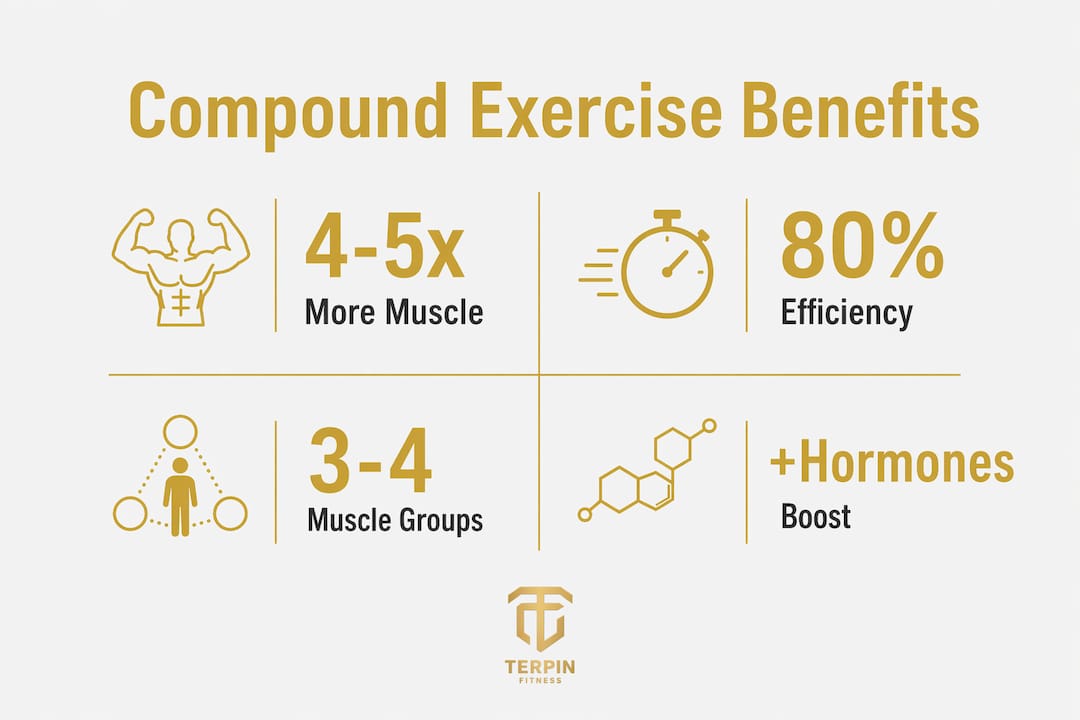
Compound movements deliver more training stimulus per minute than any other exercise category. That efficiency comes from the sheer number of muscles involved in each rep.
Time efficiency and muscle activation
A single set of barbell rows trains the lats, rhomboids, rear deltoids, biceps, and spinal erectors at once. Replicating that stimulus with isolation exercises would require four or five separate movements. Compound movements optimize workout efficiency by engaging multiple muscle groups, reducing session length while increasing total stimulus.
Neural drive and hormonal response
Compound lifts produce a stronger neural drive than isolation exercises. Your nervous system recruits more motor units to coordinate movement across multiple joints, which accelerates strength gains in the early months of training. Compound exercises provide superior neural drive, systemic hormonal response, and measurable progressive overload advantages over isolation exercises. That hormonal response is real: heavy squats and deadlifts trigger a greater release of testosterone and growth hormone than bicep curls.
Functional strength and cardiovascular benefits
“Functional movement patterns trained by compound exercises translate directly to daily activities and athletic performance.”
Picking up a heavy box, climbing stairs, and carrying groceries all mirror the hip hinge and squat patterns. Training those patterns in the gym builds strength that transfers outside it. Heavy compound lifts also provide cardiovascular benefits through elevated heart rate, combining strength and endurance training in a single session. That dual effect makes compound-focused workouts especially efficient for people with limited time.
Key benefits at a glance:
Trains multiple muscle groups in one movement
Builds functional strength for daily life and sport
Produces stronger hormonal and neural responses
Elevates heart rate for a combined cardio effect
Allows clear, measurable progressive overload
How do compound exercises compare to isolation exercises?
The compound versus isolation debate is one of the most common questions in strength training. The honest answer is that both have a place, and the research supports a clear programming hierarchy.
Hypertrophy outcomes when volume is matched
No statistically significant difference in muscle hypertrophy exists between compound and isolation exercises when total training volume is matched. That finding matters because it tells you the muscle does not care whether the stimulus came from a barbell squat or a leg press. What matters is total volume over time. The practical implication is that compound lifts are not magic. They are efficient, not irreplaceable.
Where isolation exercises earn their place
Isolation exercises are necessary to target specific weak points due to kinetic chain limitations during compound movements. A classic example: the triceps are the limiting factor in many people’s bench press long before the chest is fully fatigued. Adding tricep pushdowns after your bench session addresses that gap without adding another heavy compound set.
The recommended split for beginners through early intermediates is the 80/20 ratio mentioned above. After 12–18 months of consistent training, isolation work becomes more important as compound lifts alone can no longer fully load every muscle group.
When to prioritize each:
Compound first: Building a base of strength, improving coordination, maximizing time efficiency
Isolation after: Addressing lagging muscle groups, managing fatigue, adding volume safely
Technical skill and progressive overload
Compound lifts require more technical skill than isolation exercises. A leg curl has one moving part. A deadlift has dozens of variables: foot position, hip hinge depth, bar path, bracing, and lockout. That complexity is also an advantage because it gives you clear, objective markers for progress. Adding five pounds to a deadlift is a concrete measure of improvement that a cable fly cannot match.
What are the best practices for performing compound exercises safely?
Safe compound lifting starts with understanding the six fundamental movement patterns: squat, hinge, push, pull, lunge, and carry. Every compound exercise fits into one of these categories.
The six movement patterns
Squat: Barbell back squat, goblet squat, front squat. Loads the quads, glutes, and core.
Hinge: Deadlift, Romanian deadlift, kettlebell swing. Loads the hamstrings, glutes, and lower back.
Push: Bench press, overhead press, push-up. Loads the chest, shoulders, and triceps.
Pull: Pull-up, barbell row, cable row. Loads the lats, rhomboids, and biceps.
Lunge: Walking lunge, split squat, step-up. Loads the quads and glutes unilaterally.
Carry: Farmer’s carry, suitcase carry. Loads the core, traps, and grip.
Common errors and how to fix them
The most frequent mistake beginners make is loading too much weight before mastering the movement pattern. A rounded lower back on a deadlift, a caved knee on a squat, or a flared elbow on a bench press all signal that the weight exceeds current skill. The fix is always the same: reduce the load, drill the pattern, then add weight gradually.
Core engagement is the single most overlooked element in compound lifting. Bracing your core before every rep protects the spine and transfers force more effectively through the kinetic chain. Think of it as creating a rigid cylinder around your midsection before the bar moves.
Pro Tip: Film yourself from the side on your heaviest sets. Most form breakdowns are invisible from the lifter’s perspective but obvious on video. One minute of footage can save months of injury recovery.
Progressive overload in compound lifts
Progressive overload means adding a measurable stimulus over time. For compound lifts, the clearest method is adding weight to the bar. A beginner can often add five pounds per session on squats and deadlifts for the first several months. When linear progression stalls, switching to weekly or monthly progression targets keeps the stimulus moving forward.
How can beginners build a routine around compound exercises?
A beginner’s compound-focused routine does not need to be complicated. A full-body session with 5–6 compound exercises can train all major muscle groups efficiently in 45–75 minutes. That is the target structure for the first 12–18 months of training.
Sample full-body session structure
Exercise | Pattern | Primary Muscles |
Barbell back squat | Squat | Quads, glutes, core |
Romanian deadlift | Hinge | Hamstrings, glutes, lower back |
Bench press | Push | Chest, shoulders, triceps |
Barbell row | Pull | Lats, rhomboids, biceps |
Overhead press | Push | Shoulders, triceps, upper traps |
Farmer’s carry | Carry | Core, grip, traps |
Perform this session two or three times per week with at least one rest day between sessions. Prioritize the squat and deadlift early in the session when your nervous system is freshest. Save accessory work for the end.
When to add isolation exercises
Most beginners do not need isolation exercises in the first three to six months. The compound movements provide enough stimulus to drive rapid progress across every muscle group. After that initial phase, adding one or two isolation exercises per session targets muscles that compound lifts under-load. Systemic fatigue from compound-only programming can be managed by supplementing with isolation exercises to increase total muscle stimulus safely.
Pro Tip: Track your lifts in a simple notebook or app. Seeing your squat go from 95 pounds to 185 pounds over six months is the most powerful motivator in training. Numbers do not lie.
Beginner programming priorities:
Start with two to three full-body sessions per week
Master movement patterns before adding load
Add weight consistently using a simple progression scheme
Introduce isolation work after the first 12–18 months
Keep sessions to 45–75 minutes to manage training frequency and recovery
Key Takeaways
Compound exercises are the most efficient tool for building strength, and an 80/20 compound-to-isolation ratio is the proven starting point for beginners through early intermediates.
Point | Details |
Definition matters | Compound exercises involve two or more joints and multiple muscle groups in one movement. |
80/20 ratio is the standard | Use 80% compound and 20% isolation exercises for the first 12–18 months of training. |
Hypertrophy is volume-dependent | Compound and isolation exercises produce equal muscle growth when total volume is matched. |
Pattern-based selection reduces injury | Train squat, hinge, push, pull, lunge, and carry patterns regardless of equipment available. |
Isolation fills the gaps | Add isolation exercises after 12–18 months to address muscles under-loaded by compound lifts. |
Why I think most beginners overcomplicate compound training
The most common mistake I see with new lifters in Pensacola is not poor form. It is program hopping. Someone starts squatting and deadlifting, sees progress for eight weeks, then switches to a body-part split because they read that isolation exercises are better for hypertrophy. They abandon the compound foundation before it has time to work.
The research is clear: compound exercises are foundational to measurable strength progression because of their objective overload signals. You can track a deadlift. You can add five pounds and know with certainty that you got stronger. That feedback loop is what drives long-term progress, and it is nearly impossible to replicate with isolation-only training.
The second mistake is ignoring the weakest link. Beginners often underestimate how much a weak muscle limits a compound lift. If your upper back rounds on a deadlift, the problem is not your hamstrings. It is your spinal erectors and lats. Targeted isolation work after 12–18 months is not optional for serious trainees. It is the tool that breaks plateaus.
My advice is simple. Pick five compound movements, learn them well, add weight consistently, and build an accountability routine around showing up. The isolation exercises will come later, and they will work better because you built a strong foundation first.
— Marc
Terpinfit personal training in Pensacola can build your compound program
Knowing the principles is one thing. Executing them with correct form and a program built around your body is another. Terpinfit offers both online and in-person personal training in Pensacola with programs centered on compound movements for strength and long-term results.

Every Terpinfit client starts with a movement assessment to identify weak links in the kinetic chain before loading compound patterns. From there, programming is built around your schedule, your goals, and your current fitness level. If you are ready to stop guessing and start building real strength, explore training services and find the package that fits your goals.
FAQ
What are compound exercises?
Compound exercises are multi-joint movements that activate two or more muscle groups simultaneously. Classic examples include the squat, deadlift, bench press, and pull-up.
How are compound exercises different from isolation exercises?
Compound exercises involve multiple joints and muscle groups, while isolation exercises target a single muscle through one joint. The leg press is compound; the leg curl is isolation.
Are compound exercises better for building muscle?
Research shows no significant difference in muscle hypertrophy between compound and isolation exercises when total training volume is matched. Compound lifts are more efficient, not inherently superior for muscle growth.
How many compound exercises should a beginner do per session?
A full-body session with 5–6 compound exercises covers all major muscle groups in 45–75 minutes. That structure is the recommended starting point for the first 12–18 months of training.
When should beginners add isolation exercises to their routine?
Most beginners benefit from adding isolation exercises after 12–18 months of consistent compound training. At that point, isolation work addresses muscles that compound lifts can no longer fully load on their own.
Recommended
Comments